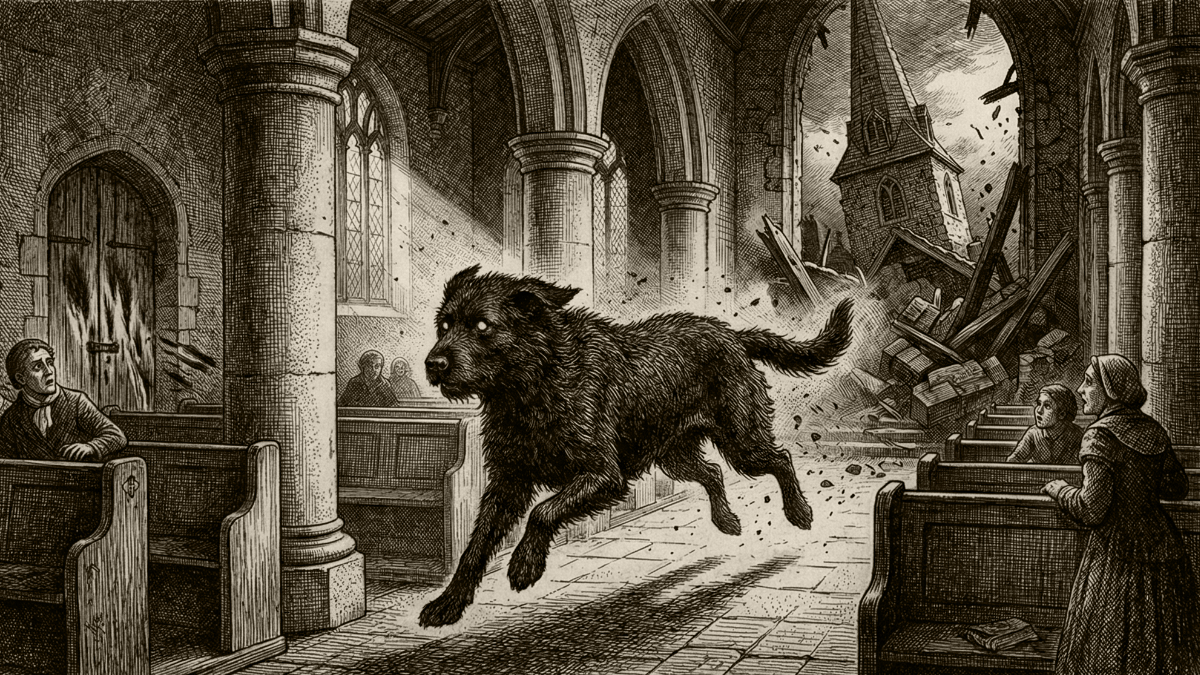
The storm broke over Blythburgh on a Sunday morning, the fourth of August 1577, while the congregation of Holy Trinity was at prayer. What happened next was recorded by a local clergyman named Abraham Fleming in a pamphlet published the same year, A Straunge and Terrible Wunder, and the account is detailed enough that it has been cited, analysed, and argued over ever since.
Fleming’s account describes a black dog entering the church and running down the nave. Two people died, Fleming says it passed between them and slew them, and a third was described as shrivelling — his words — like leather scorched in a hot fire. The steeple was struck, collapsing into the nave. Scorch marks were left on the north door.
This is Fleming’s version of events, written in the idiom of providential wonder literature: a genre designed to interpret storms and disasters as divine communication. How much is eyewitness report and how much is interpretive framework imposed after the fact is not separable at this distance.
The door is still there. The marks are still there. Holy Trinity is still there, still in use, on the Blyth estuary in Suffolk. Every year people come to look at the marks.
The name and the territory
Black Shuck takes its name from a word whose etymology is debated. The most widely cited derivation is the Old English scucca, meaning demon or fiend, a word with deep roots in the Anglo-Saxon supernatural vocabulary. Some sources suggest alternatives linked to dialect words for shaggy or rough. Whatever the root, the name is specific to East Anglia: Norfolk, Suffolk, Essex, Cambridgeshire. Beyond that territory, the black dog tradition continues under different names — the Barguest in Yorkshire, the Guytrash in Lancashire, the Shagfoal in Lincolnshire — but Shuck is East Anglian in the way that particular darkness tends to be local.
Descriptions vary considerably — large as a calf in some accounts, barely distinguishable from an ordinary dog in others, sometimes with a single eye, sometimes two glowing red or green, sometimes both. The tradition has never settled on a fixed form. He runs the roads and the coastal paths. He follows people without approaching them, or approaches them without attacking. In some versions of the tradition he is an omen of death; in others, an omen of nothing in particular, a creature whose appearance carries no predictive weight beyond its own strangeness.
This inconsistency is worth noting. Unlike the Barguest, which is consistently a death omen, Shuck’s meaning has never been fully settled. Accounts from across the centuries describe encounters that ended in death, encounters that ended in nothing, encounters that ended in the witness living a long and uneventful life. The creature seems to resist the interpretive framework that folklore usually provides.
Blythburgh and Bungay
The 1577 event had two locations. On the same morning, in the same storm, a black dog was also reported at St Mary’s in Bungay, twelve miles inland. Fleming’s pamphlet is principally about the Bungay incident; Blythburgh appears as a secondary account. The death toll across both churches varies between sources and cannot be stated with confidence; different retellings assign different numbers to each location. What is consistent across the accounts is that people died in both churches, that the steeple at Bungay suffered damage, and that the storm was severe enough to cause destruction that needed explaining.
Two churches, one storm, one morning, twelve miles apart. The detail that has attracted most attention from people inclined toward rational explanation is that both events occurred during what appears to have been an exceptionally severe electrical storm, the kind capable of producing ball lightning, which moves through enclosed spaces, causes burns without obvious mechanism, and can kill without leaving visible wounds. This is the same explanation advanced for the Widecombe thunderstorm of 1638, and it is probably correct in the same way and to the same degree: plausible, consistent with the evidence, and not quite sufficient to close the question of why people in both churches saw a dog.
The Blythburgh marks have been examined. They are real marks on real wood. Whether they were made in 1577, or are the accumulated result of centuries of candle smoke, weathering, and Suffolk damp, is not established. The church itself does not claim certainty.
The coastal paths
Away from the church accounts, the bulk of Shuck’s documented appearances are on roads and coastal paths, the lanes of the Norfolk Broads, the shingle tracks of the Suffolk coast, the drove roads running inland from the sea. These are liminal landscapes in the specific sense: edges, boundaries, the places between habitation and open water, between farmland and heath. The black dog tradition across northern Europe clusters consistently at these edges, which may be coincidence or may reflect something about the kind of attention people bring to boundary landscapes at night.
The sightings tend to follow a pattern. A traveller alone on a path, usually at night, becomes aware of a large dog pacing alongside them. The dog does not attack. It maintains its distance. If the traveller stops, the dog stops. If they run, the dog runs. Eventually it is simply no longer there, not seen to leave, not heard to depart, simply absent where it was present a moment before.
This is a less dramatic encounter than the Blythburgh church account, but it is the more common one and in some ways the more unsettling. There is nothing to do with a creature that simply accompanies you. You cannot flee it because flight changes nothing. You cannot appease it because it has made no demand. You can only walk, with something large and glowing-eyed beside you in the dark, until it decides, or whatever it does that resembles deciding, to leave.
Shuck and the sea
East Anglia’s relationship with the North Sea runs through the Shuck tradition in ways that are not always explicit. This is a coastline of erasure; the medieval city of Dunwich is under the water, consumed by centuries of erosion, and the sea has been taking the Suffolk and Norfolk coast for as long as anyone has recorded it. The coastal paths Shuck is said to haunt are paths that change, that disappear, that exist this year and are gone the next. The drowned bells of Dunwich allegedly still ring beneath the waves.
There is a version of the Shuck tradition that places him specifically as a guardian of the coast, a creature associated not with death but with the boundary between land and sea, maintaining something that the sea is always trying to dissolve. This is a minority interpretation and it sits uneasily with the Blythburgh church account. But it gestures at something real about the landscape: that the East Anglian coast is a place where permanent things are not permanent, where the ground underfoot has been lost before and will be lost again, and that the local imagination has produced a creature whose territory is exactly this — the edge of things, the path that may not be there tomorrow.
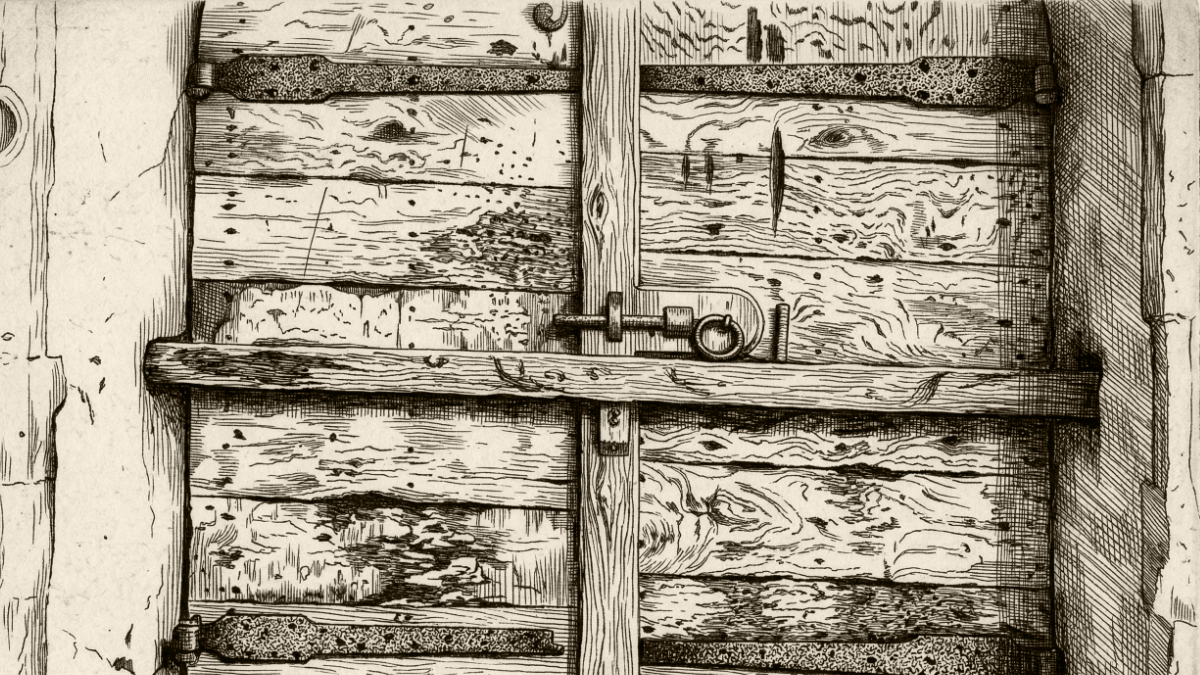 Two darkened patches in the old timber, roughly the size of hands
The marks on the door
Holy Trinity Blythburgh is a remarkable building, high and light and largely unchanged since the medieval period, known locally as the Cathedral of the Marshes. The nave is long, the roof painted with angels, the windows large enough that the light inside has a particular quality on clear days. It is not a dark or threatening place.
The north door is in the west porch. The marks are at roughly shoulder height, two darkened patches in the old timber, roughly the size of hands, separated by a foot or so. Whether they are claw marks, scorch marks, or simply the marks of centuries, is a question the church itself declines to answer definitively. The door is listed. The marks are part of what is listed.
Every account of Black Shuck ends somewhere. Most end with the creature simply not being there anymore, the road empty, the path quiet, the witness arrived home without quite knowing when the presence beside them became absence. The Blythburgh account ends differently, with physical evidence, with dead bodies, with marks on a door that four and a half centuries of Suffolk weather has not removed.
Something was there. What it was has not been agreed upon. The door stands open most days, and the marks are at the height where something large might have pressed against it, going out.