Lady Mabella Tichborne was dying — sometime in the twelfth or thirteenth century, the accounts differ and no precise date is established — and she wanted to leave something behind. Not for herself — the accounts are consistent on this — but for the poor of the parish, who depended on the charity of the Tichborne estate in a way that the estate had not always honoured. She asked her husband, Sir Roger, for land from which she could endow a perpetual dole: flour, distributed annually to anyone in the village who came to claim it.
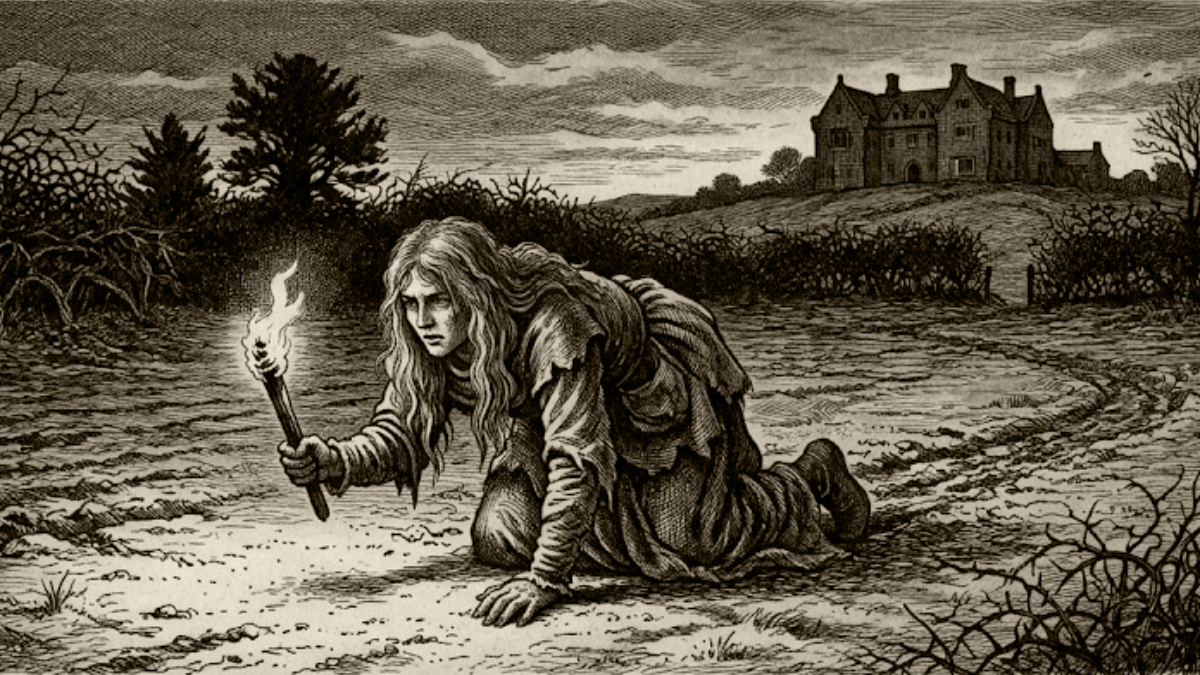
Sir Roger was not, by the available evidence, a generous man. He told her she could have whatever land she could crawl around before the torch she was holding went out.
He may have expected her to manage a kitchen garden. Lady Mabella, bedridden and dying, had herself carried to the fields. She crawled. She crawled across twenty-three acres of good Hampshire farmland before her torch guttered and went dark, and the field has been known as The Crawls ever since.
The terms of the dole
Before she died, Lady Mabella set conditions on the land. Every year, on the Feast of the Annunciation, 25 March, the Tichborne family was to distribute flour from The Crawls to all who came to claim it. The dole was to be open to anyone: not just the village poor, not just those who could prove need, but anyone who appeared at the house and asked. This universality was deliberate. It was harder to quietly discontinue a dole that anyone could witness.
She also attached a curse. If the dole were ever discontinued, the family would suffer: a generation of seven sons would be followed by a generation of seven daughters, after which the Tichborne name would die out entirely. Some versions of the legend add further elaboration — a crumbling house, a fallen yew — but the core form of the curse is demographic. The specificity is unusual: not simply misfortune, but a sequence of events precise enough to be verified against the family’s actual history.
The Tichborne family distributed the dole for six centuries.
The lapse and its consequences
In 1796, Sir Henry Tichborne discontinued the dole. The reasons given were practical: the annual distribution had begun to attract not just the local poor but itinerants from across Hampshire, and the gathering had become, in the family’s view, disorderly. Several hundred people appearing annually at a country house was inconvenient. The dole was stopped.
Within a generation, the curse had apparently delivered. Sir Henry’s son had seven sons. Those sons produced seven daughters between them, and not a single male heir. The Tichborne baronetcy, which had passed through the male line continuously since the Norman period, faced extinction.
The family took the curse seriously enough to restore the dole in 1836. They have distributed it every year since, in a ceremony that now draws considerable attention — the family and the villagers assembled on the lawn at Tichborne House, the flour weighed out in the old measures, the distribution conducted with the formal quality of something that knows it is being watched.
The Tichborne Claimant
The family’s difficulties did not end with the restoration of the dole. In 1866, a man arrived from Australia claiming to be Sir Roger Tichborne, the eldest son of the family who had been presumed lost at sea in 1854. He was enormous; Roger Tichborne had been slight and delicate, and he spoke no French, though Roger had been educated in Paris. He could not recall basic details of his own childhood. He claimed that twelve years in the Australian bush had changed him.
Lady Tichborne, Roger’s mother, accepted him immediately and completely. She recognised him, she said, by his ears. Other members of the family did not recognise him at all.
The resulting legal proceedings became the longest and most expensive trial in English legal history to that point. The claimant, eventually identified as Arthur Orton, a butcher from Wapping, was tried for perjury, convicted, and sentenced to fourteen years. Lady Tichborne died before the verdict. Whether she had genuinely believed in him, or had wanted so badly to believe that the question of truth had become secondary, was not resolved by the court.
The Tichborne case is a separate story from the dole, but it occupies the same ground. Both are about the weight of a family name, the obligations it carries, and what happens when those obligations are not met, whether through discontinued charity or fraudulent claim. The family was still, in the 1860s, living inside the consequences of what Lady Mabella had set in motion seven centuries earlier.
The ceremony now
Tichborne House still stands outside the village of Tichborne, between Alresford and Winchester, at the end of a private drive in the Itchen valley. The house is not open to the public. The dole ceremony is.
Every 25 March, the current baronet and his family distribute flour to the assembled village. The quantities are set by the original terms — a gallon for adults, half a gallon for children — and the flour comes from the estate. The ceremony is photographed, reported on, occasionally televised. It has become, like most very old things that have survived into the present, a mixture of genuine tradition and self-conscious performance. The family knows the cameras are there. The villagers know the family knows.
None of this diminishes it, exactly. The dole has been distributed for the better part of nine hundred years, with one twenty-year interruption that the family has spent the subsequent two centuries treating as an object lesson. The Crawls is still the name of the field. The house is still standing. The flour still arrives.
Lady Mabella crawled twenty-three acres of frozen Hampshire farmland on her hands and knees so that people she would never meet would have bread. Whatever Sir Roger intended by his offer, she converted it into something that has outlasted every person in this story by centuries.
The torch went out. The curse held. The dole continues.