The service had already begun when the storm arrived. It was a Sunday afternoon in late October, and the congregation of St Pancras, Widecombe-in-the-Moor, had settled into their pews for the sermon. Outside, the weather had been building — a darkness coming in fast from the direction of Dartmoor, unusual even for autumn on the high moor. Then the church was struck.
What happened in the next few minutes killed four people, injured sixty more, and left physical evidence so strange that it was being written about, argued over, and attributed to the direct intervention of the devil for decades afterward. A pamphlet published within weeks of the event sold widely across England. The church still bears the marks.
The building
St Pancras at Widecombe is a granite moorland church, substantial and old, with a tower that stands as a landmark across the surrounding farmland. In 1638 it was full, a rural congregation gathered for the afternoon service, perhaps three to four hundred people in a building designed to hold them. The sermon had begun. A man named George Lyde was in the pulpit.
At some point during the service, the sky outside turned the colour of pitch. Contemporary accounts describe a darkness falling suddenly, mid-afternoon, in the manner of an eclipse. Then came the noise, described variously as a crack like a cannon, a clap of extraordinary violence, and a sound that several survivors said they felt rather than heard — a concussion passing through the body before the ears registered anything.
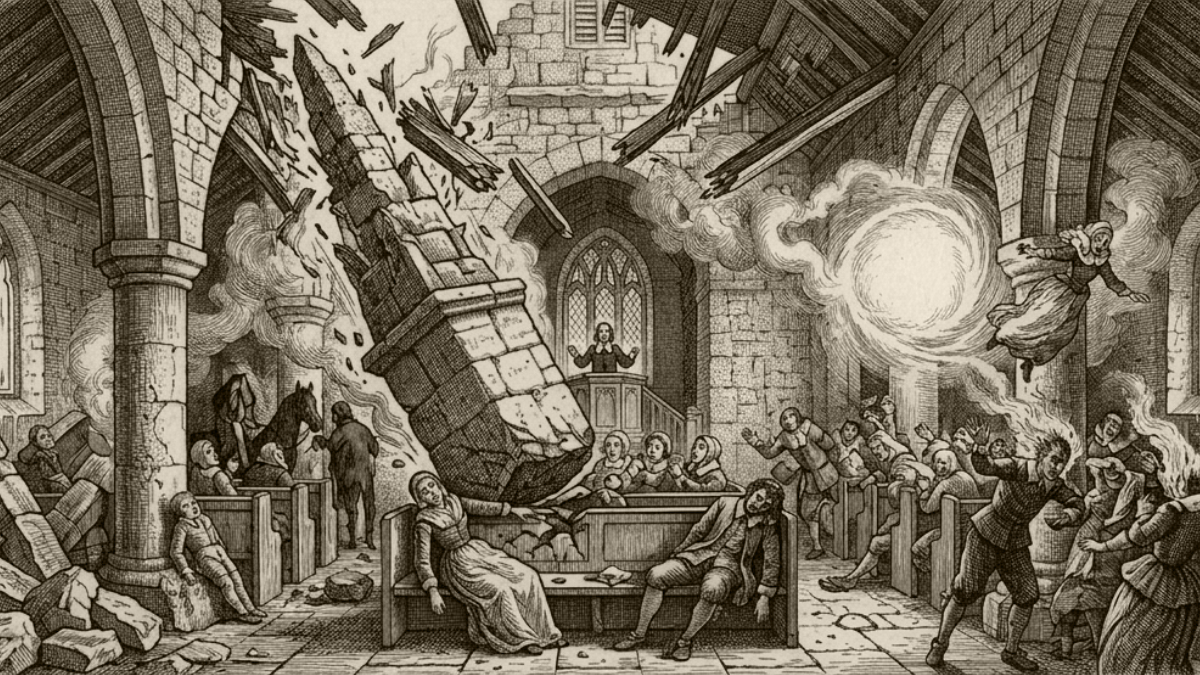
The south face of the tower was struck. A pinnacle — a large decorative stone finial at the tower’s corner — was torn free and driven through the roof of the nave. It did not fall cleanly. It came through at an angle, carrying roof timbers with it, and landed among the congregation.
The dead
The first to die was a man whose name the pamphlet renders as Robert Mead. A beam from the collapsing roof struck him across the head. The account is specific about the injury: his skull was fractured and his brains were described as dashed out against the wall. He was sitting with his wife. She survived.
The second death was a woman named Mary Woodley. She was found after the confusion had subsided without any visible injury — no wound, no bruising, no mark of any kind on her body. She was simply dead. Contemporary accounts found this more unsettling than the beam deaths, because it offered no mechanism, nothing to point to, nothing that made sense in the ordinary vocabulary of accident and physics.
The third was a child. A boy, unnamed in most accounts, who died of injuries sustained when part of the interior stonework gave way. The details of his injuries are not recorded with the same precision as the adults; the pamphlet moves quickly past him.
The fourth death came later. A man named Roger Hill, who had been sitting near the point of impact, lingered for some days and then died of his wounds. The accounts describe burns on his body that had no obvious source; he had not been near any open flame, and the storm had not started a fire in the conventional sense.
The injured
The sixty-odd injured present a catalogue of injuries that reads, at points, like something from a considerably more violent context than a church service in Devon.
Several people had their clothes burned or scorched from their bodies while the flesh beneath was unharmed, or, in some cases, the reverse — flesh burned while the clothing remained intact. A man named John Hill had his head violently singed, his hair burned away. A woman identified only as Mistress Ditfield had her ruff, the stiff collar fashionable in the period, set alight, but the skin of her neck was unburned.
One account describes a man whose shoes were found some distance from where he had been sitting, with no explanation for how they came to be there. Another describes a woman who was lifted from her pew and carried some feet through the air before being deposited, alive and largely uninjured, against a pillar. She was conscious throughout and described the sensation in terms that the pamphleteer found difficult to render into acceptable prose.
The smell reported by survivors is worth noting: a strong sulphurous odour that filled the church immediately after the impact and persisted for some time. Several people described becoming nauseated by it. One account says the windows ran with a liquid that could not be identified and that smelled of brimstone.
The stone in the pew
The fallen pinnacle came to rest, eventually, partly embedded in a pew near the centre of the nave. The pew was occupied. The accounts differ on the exact number of people in it at the moment of impact, somewhere between two and five, but are consistent on one point: the stone landed among them and none was killed by it. Two were badly injured. The stone itself was large enough, and had fallen from high enough, that the survival of anyone in its path was considered remarkable.
The pew remained. The stone, for a period, remained. People came from surrounding parishes to look at them. The physical evidence of the event was treated, in the weeks and months following, as something close to a relic, proof of what had occurred, and of who had caused it.
The devil’s explanation
The pamphlet published shortly after the event, A True Relation of Those Sad and Lamentable Accidents which happened in and about the Parish Church of Withecombe, was not primarily concerned with meteorological explanation. It was concerned with meaning. And the meaning it advanced was straightforward: the devil had come to Widecombe to collect a debt.
The story attached to this interpretation centred on a man in the congregation whose name was not given but whose sin was specified: he had sold his soul, and the note of hand was due. A stranger had been seen outside the church before the service, on a large black horse, asking directions to Widecombe. He had stopped at a local inn and ordered ale. When the pot was brought to him, the ale seethed and boiled in the cup without being heated. He left without paying. His horse, tied outside, was later found to have scorched the roof tiles where it stood.
The stranger, the pamphlet argued, had arrived to collect his debtor. The violence was collateral; the devil, entering the church, had caused the storm as a side effect of his presence. The four deaths and sixty injuries were the incidental damage of a supernatural transaction.
This explanation was taken seriously by a significant portion of the reading public. It fit an existing framework; the soul-selling compact was a well-established piece of theological and popular tradition, and the physical evidence was genuinely anomalous enough that a supernatural cause seemed no less plausible than a natural one.
What actually happened
The most widely cited modern interpretation is that the church was struck by ball lightning, a phenomenon poorly understood even now, but documented extensively enough to be accepted as real. The event is frequently referenced in meteorological literature as an early reported case, though it is generally presented as a strong apparent example rather than a fully settled conclusion. Ball lightning presents as a luminous sphere of electrical plasma, variable in size from a tennis ball to several feet in diameter, that moves independently of the storm that generates it, passes through solid objects, causes burns without apparent mechanism, and disappears suddenly. It can kill without leaving visible injury. It produces a strong ozone smell that, to anyone without chemistry, is indistinguishable from brimstone.
Ball lightning would account for Mary Woodley’s uninjured death, for the directional burns, for the scorched clothes with unburned skin beneath, for the windows running with an unidentified liquid, for the smell. It would account for the woman carried through the air. It does not fully account for the structural damage to the tower, which appears to have been conventional lightning strike, but the two events may have been simultaneous.
The ball lightning explanation was not available to the people of Widecombe in 1638. They had the evidence in front of them — the bodies, the burns, the brimstone smell, the stone in the pew — and they reached for the explanatory framework their world provided. The devil had been there. The marks proved it.
What remains
The Church of St Pancras was repaired. The tower was rebuilt. A board inside the church records the event in plain language — the date, the deaths, the injuries — in the manner of a factual memorial. It has been there, in one form or another, since the seventeenth century.
Widecombe-in-the-Moor is a tourist destination now, famous principally for a folk song about a fair and a grey mare. The thunderstorm is a secondary attraction, mentioned in the guidebooks, a footnote to the more cheerful local mythology. The church is visited by people who walk Dartmoor and want somewhere to stop.
What the building itself retains is harder to characterise. The granite is old, the tower rebuilt but on original foundations, the nave still oriented as it was in 1638. In the right conditions, an October afternoon, the light going early, the moor visible through the south window, it is possible to sit in the pews and feel the precise quality of that Sunday afternoon more vividly than you might want to.
Four people did not leave this building. Whatever came through the roof that day — ball of plasma, debtor’s escort, or something that has not yet been adequately named — it killed them in this specific space, among people who knew them, while a man stood in the pulpit and the service proceeded around the catastrophe until it could not.
The smell, apparently, lingered for weeks.