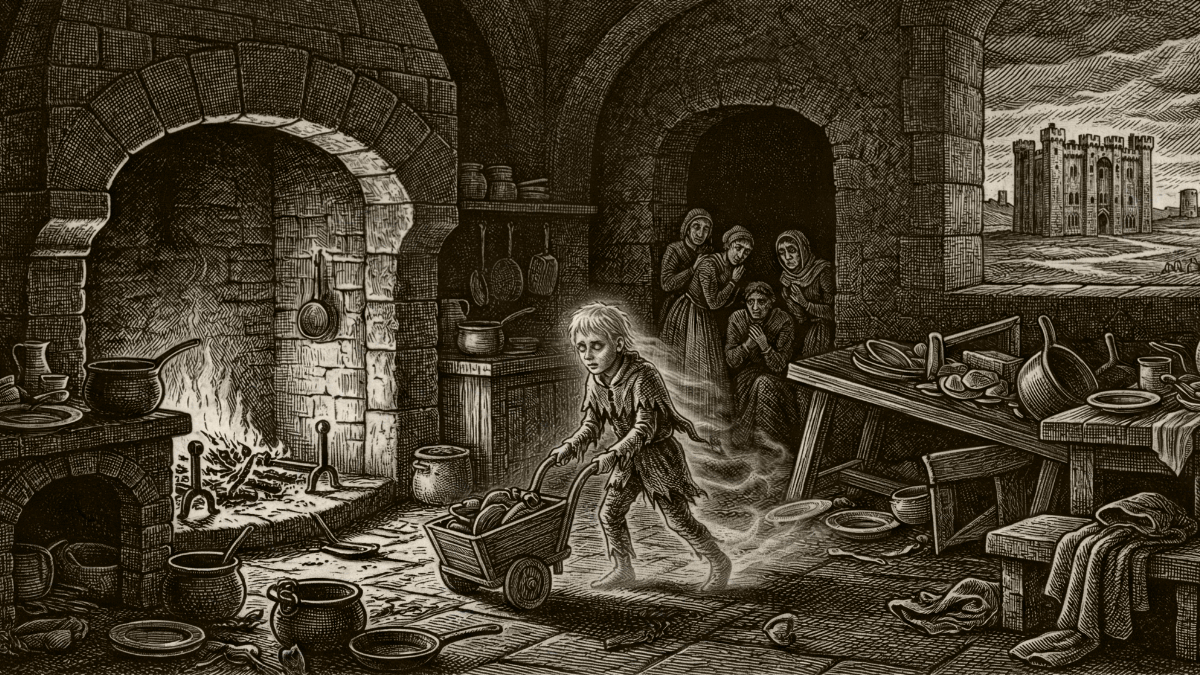
The kitchens of Hylton Castle had a particular problem. What had been left tidy at night was disordered by morning, pots moved, dishes rearranged, work undone or redone according to no logic the servants could identify. If the kitchen was left in a mess, it would be found clean and ordered. If it was left clean and ordered, it would be found in chaos. Whatever was doing this was not malevolent in any straightforward sense. It was playful, or perhaps simply restless. It worked through the night, invisible and cold.
The servants heard it sometimes. A voice, thin and unhappy, repeating the same words in the dark:
Wae’s me, wae’s me. The acorn’s not yet fallen from the tree that’s to grow the wood, that’s to make the cradle, that’s to rock the bairn, that’s to grow the man, that’s to lay me.
It is a lament about time, specifically about how much of it remains before the ghost can be laid to rest. The oak that will eventually provide the cradle that will eventually rock the child that will eventually become the man who will perform the laying has not yet grown from an acorn. Rest is impossibly distant. The Cauld Lad of Hylton had been waiting a long time, and saw no end to the waiting.
The boy in the castle
The legend has a historical anchor, which is unusual for this type of haunting. Roger de Hylton, lord of Hylton Castle in the late fourteenth or early fifteenth century, was said to have killed a stable boy named Roger Skelton in a moment of anger; the accounts vary on the precise circumstances, but the most common version has Hylton striking the boy with a scythe or a hay fork when he found the horses had not been properly readied. The boy died of the wound. Hylton was pardoned, as lords were, and the matter was officially closed.
It was not closed in the castle.
The Cauld Lad, the cold boy, the child ghost, took up residence in the kitchens and continued to be resident there for as long as Hylton Castle was inhabited. He was cold because the dead are cold, or because he had lain undiscovered for some time before anyone found him, or simply because that is the nature of the thing that haunts: something arrested at the moment of death, unable to warm itself by any fire the living can provide.
Whether Roger Skelton ever existed as a documented individual is not established. The pardon for Roger de Hylton exists in the historical record, though its connection to a stable boy killing is an inference rather than a certainty. The legend attached itself to the building and found a name for what was haunting it, which is what legends do.
The gift and the going
The servants’ solution to the Cauld Lad was a standard one in English brownie folklore — the gift of clothing. A cloak and hood were left by the hearth. The logic, consistent across dozens of similar traditions, is that a spirit bound to a place by some unresolved condition can be released by a gift of clothing, which either satisfies an obligation or confers a kind of dignity that allows departure. The spirit accepts the gift, puts it on, and is seen no more.
This is what happened at Hylton. The cloak and hood were left out. In the small hours, the servants who had stayed awake to watch reported hearing the Cauld Lad find them — a rustling, a sound of satisfaction — and then his voice one last time, changed in character from the usual lament:
Here’s a cloak, and here’s a hood. The Cauld Lad of Hylton will do no more good.
And then silence. And then, in the morning, nothing. The kitchens were neither tidied nor disordered. The voice was not heard again. He was gone.
What the ending means
There is a quality to this ending that distinguishes it from most folklore resolutions. The Cauld Lad is not defeated, not driven out, not exorcised by prayer or confrontation. He is given something, and he leaves of his own accord. The liberation is willing.
But the servants’ reaction to his going, in several accounts, is not entirely celebratory. They had lived with him for a long time. His mischief was manageable, even characterful — the disordered kitchen, the rearranged pots, the thin voice in the dark. These were, in their way, a kind of presence. The castle without him was quieter and emptier than the castle with him, and whatever had animated those nightly disturbances was now simply absent.
This ambivalence is the most interesting thing in the legend. The brownie tradition across British folklore tends to treat the departure of a house spirit as loss rather than relief; the spirit had been part of the household’s life, and its going leaves a vacancy. The Cauld Lad, who had been making mischief out of cold and misery, turns out to have been filling a space that nothing else fills when he is gone.
The castle now
Hylton Castle still stands, after a fashion. What remains is the fourteenth-century gatehouse tower, substantial, roofless, maintained by English Heritage in the middle of a Sunderland suburb. The surrounding estate is long gone, the grounds absorbed by housing development across the twentieth century. The tower stands on a low rise with a car park at its foot and a view of residential streets in every direction.
It is a building that has been stranded by time, which is perhaps appropriate. The Cauld Lad was also stranded, held between his death and some impossible future release, listening to the castle’s nights and working through its kitchens out of nothing more purposeful than the need to do something with eternity.
The kitchens no longer exist. The hearth where the cloak was left is gone. If the Cauld Lad came back now there would be nowhere to put him, and nothing to disturb.
There is a local tradition that he was last seen on the night before the kitchens were demolished, standing in the rubble, watching, wearing his cloak and hood, cold as he always was. The tradition is probably not old. It has the feeling of something invented to give a building its ending.
But it also has the feeling of something that, if it did not happen, perhaps should have.