There is a gill in the limestone country above Appletreewick where the locals will not walk after dark. Troller’s Gill, a narrow ravine cut into the carboniferous rock of Wharfedale, deep enough that the sky above it narrows to a white strip, shallow enough that sound behaves strangely inside it. Water runs along the floor. Moss covers everything. In daylight it is beautiful in the particular, indifferent way of the Yorkshire Dales. After dark, it belongs to something else.
The Barguest has been recorded across the north of England for centuries. It appears in the folklore of Durham, Northumberland, and across the West Riding, known variously as the Bargest, the Shagfoal, the Guytrash. But its attachment to Troller’s Gill is older and more specific than most, and the accounts from that valley have a consistency that the other sightings lack.
What the Barguest is
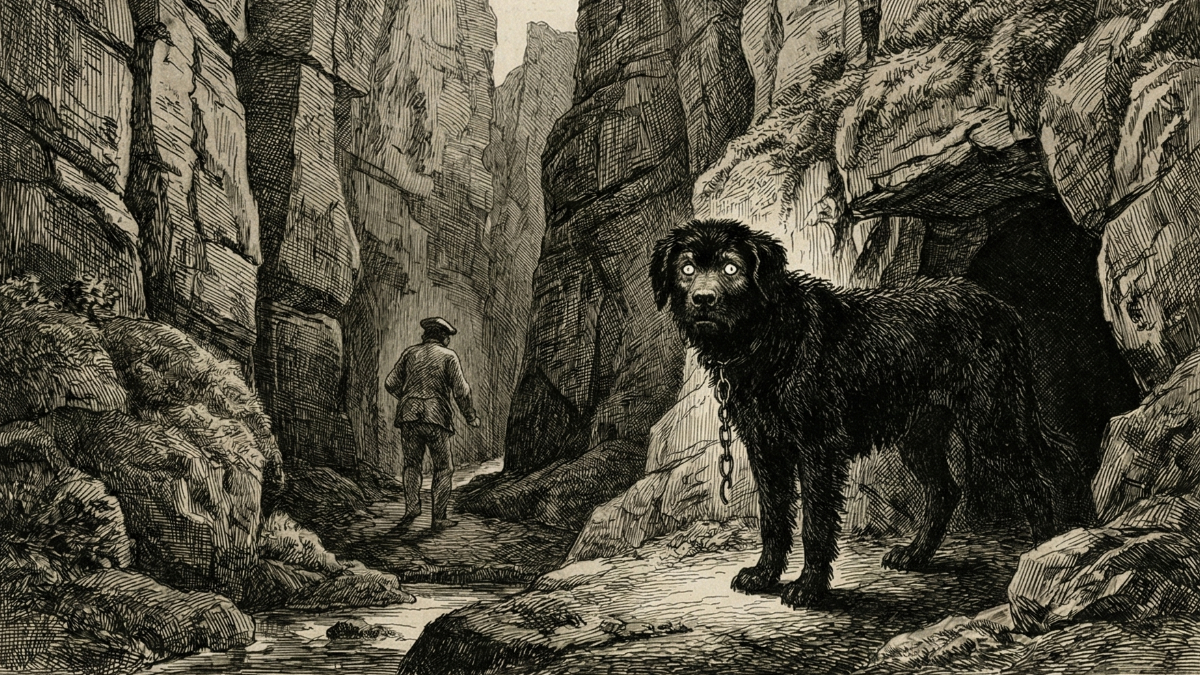
The creature is a black dog. That much is agreed upon. A dog the size of a calf, with eyes that glow — not metaphorically, as in bright or fierce, but literally — as fire glows, casting light onto the ground around them. The earliest accounts describe its paws as leaving no marks. Later ones mention a rattling of chains, though whether the chains are physical or spectral is never made clear. In some tellings, the sound precedes the creature by minutes, giving you just enough time to understand what is coming.
The name is contested. Some etymologists derive it from the Old Norse berg-geist, the spirit of the rock. Others from bier-geist, the spirit of the funeral bier, a ghost that haunts the dying. The second etymology would fit what the Barguest does. It does not attack. It does not chase. It appears to those who are about to die, or to those who will shortly lose someone close to them, and then it vanishes. The death follows within days.
This makes the Barguest unusual among black dog folklore. The Black Shuck of East Anglia kills directly, reportedly tearing through the doors of Blythburgh Church in 1577 and leaving scorch marks that are still shown to visitors today. The Barguest is more patient. More knowing. It arrives like a letter that cannot be unread.
The gill itself
Troller’s Gill runs for perhaps half a mile through the limestone above Skyreholme Beck. The name troller likely derives from the Old Norse troll, the same root that gives us the Scandinavian supernatural category, carried south by the Danelaw settlers who reshaped the vocabulary of northern England. The gill is troll country in the literal, etymological sense: a cleft in the rock where old things live.
The gorge was formed by the same process that created the surrounding karst landscape, slightly acidic rainwater dissolving the limestone along joint lines over millennia, opening fissures, collapsing caves, leaving vertical walls where the rock simply parted. Geologically it is explicable. Standing inside it at dusk, that explanation feels insufficient.
Several eighteenth-century accounts place the Barguest specifically at the upper end of the gill, near a shallow cave known locally as the Troll Hole. The animal is said to emerge from the cave mouth and stand at the edge of the beck, watching. It does not approach. When witnesses flee, and they always flee, it does not follow.
The last recorded encounter
The most recent account that merits serious attention comes from 1881, recorded by the antiquarian William Grainge in his collection of Yorkshire folklore. A farmer from Skyreholme, returning late from Grassington market, took the path through the gill rather than the longer route around the hill. He was not drunk, Grainge is careful to note. He was known as a sober and practical man, not given to superstition.
He encountered the creature near the Troll Hole. His description is precise: black, enormous, eyes like lanterns, perfectly silent except for the chain-rattle that seemed to come from everywhere at once. He stood still. The dog regarded him. After some time — he could not say how long — it turned and walked back into the cave mouth, and was gone.
He went home, told his wife, and went to bed. His brother died three days later, of an apoplexy, in Leeds.
Grainge notes this without comment, which is more unsettling than any comment would have been.
Why it persists
The rational interpretation is straightforward. A dark ravine, a large dog, possibly a stray, possibly a farmer’s animal at large — and human pattern-matching doing what it always does, connecting the sighting to the next misfortune in a life that, in nineteenth-century rural Yorkshire, contained a great many misfortunes. The glowing eyes are reflection. The size is fear’s amplification. The subsequent death is coincidence given meaning by grief.
This is probably correct.
What it does not explain is why this particular location has generated this particular account in this particular form for at least three hundred years. Folklore is conservative. It clings to places. Something about Troller’s Gill, its acoustics, its darkness, its deep connection in the local imagination to the pre-Christian world that the Danelaw settlers brought with them and never fully relinquished, has kept the Barguest there, returning it generation after generation.
The gill is still accessible. The footpath from Skyreholme is well-marked. Most visitors walk it between April and October, in the middle of the day, and find it peaceful.
The sensible approach, if you intend to visit, is to do the same.