Still water in Lancashire has a particular quality in the right conditions. When duckweed covers a pond in summer, the surface becomes opaque, a flat, unbroken green that looks almost solid, almost like ground. Children have stepped onto it. Some of them have not come back up.
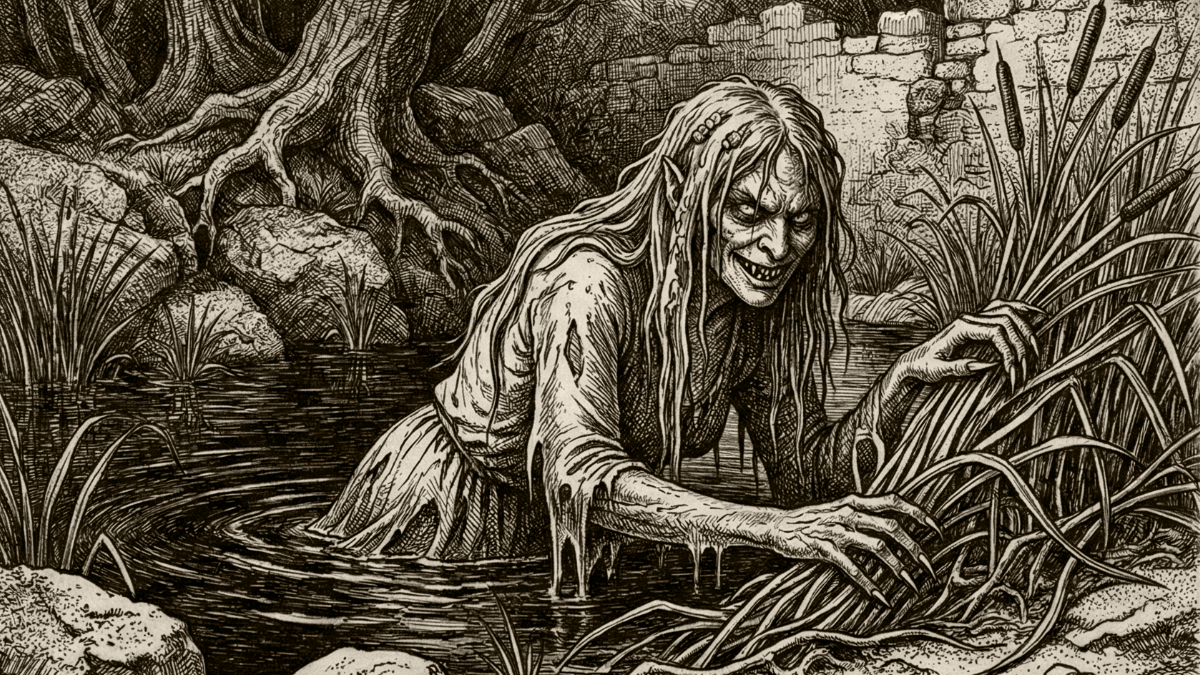
Jenny Greenteeth lives beneath that surface. She is old, green-skinned, thin-armed, with long hair that spreads through the water like weed and teeth that are sharp and numerous and the same colour as her skin. She waits. When something comes close enough to the edge, a child reaching for something, a person leaning too far over the bank, she reaches up and takes it.
She does not pursue. She does not leave the water. She simply waits, and in the patience of her waiting she is more frightening than anything that chases.
The child-warning tradition
Jenny Greenteeth belongs to a specific and widespread category of British water spirit: the nursery bogeyman, the creature invented or elaborated to keep children away from dangerous places. Every county with dangerous water has a version — Peg Powler in the Tees, Grindylow in Yorkshire, Nelly Longarms in Cheshire and Shropshire. Lancashire, with its mill ponds, its mosses, its slow rivers thick with weed, had Jenny.
The function is transparent and practical. Telling a child that the pond will swallow them is abstract; telling them that something in the pond is waiting to pull them under is immediate and visceral and memorable. The green skin and the teeth and the hair trailing through the water are not gratuitous; they are the details that make the warning stick. A child who has been told about Jenny Greenteeth will not lean over the edge of a duckweed pond to see what is underneath it.
Whether this entirely explains her is another matter. The nursery-bogeyman theory treats these figures as inventions with a rational purpose, tools for hazard communication wrapped in folklore. It is probably correct, as far as it goes. What it does not account for is why the figures persist long after the children who were warned about them have grown up, or why the descriptions across different counties and different centuries are so consistent — the green, the teeth, the hair, the patience, the waiting.
Something about still water with a covered surface produces this particular image reliably. The theory explains the function. It does not fully explain the image.
Weed and water
The duckweed association is specific to Jenny and is worth dwelling on. Other water spirits lurk in rivers, in wells, in open lakes. Jenny’s element is the covered surface, the pond where you cannot see what is underneath because the weed has sealed it over. This is a different kind of danger from the obvious depth of open water. It is a deceptive danger, a surface that looks like ground, a solidity that is not there.
In Lancashire the relevant plant is most often Lemna minor, common duckweed, which can cover a still pond so completely in warm weather that the water beneath becomes entirely invisible. It is bright green, which is where Jenny’s colouring comes from; she is the colour of the thing that hides her, or she is the thing that hides beneath it, or she is both. The taxonomic line between the woman and the weed, in the legend, is not clearly drawn.
There are accounts from the nineteenth century of Jenny being blamed for deaths in specific ponds, named ponds in named parishes, which gives the tradition a geographical precision unusual in water spirit folklore. She was not a general hazard but a local one, not just any still water but this pond, this mill race, this particular stretch of the river at this time of year when the weed was thick. The localisation suggests the legend was being used to mark genuinely dangerous places, functioning as a kind of living map of where children had drowned and where they might drown again.
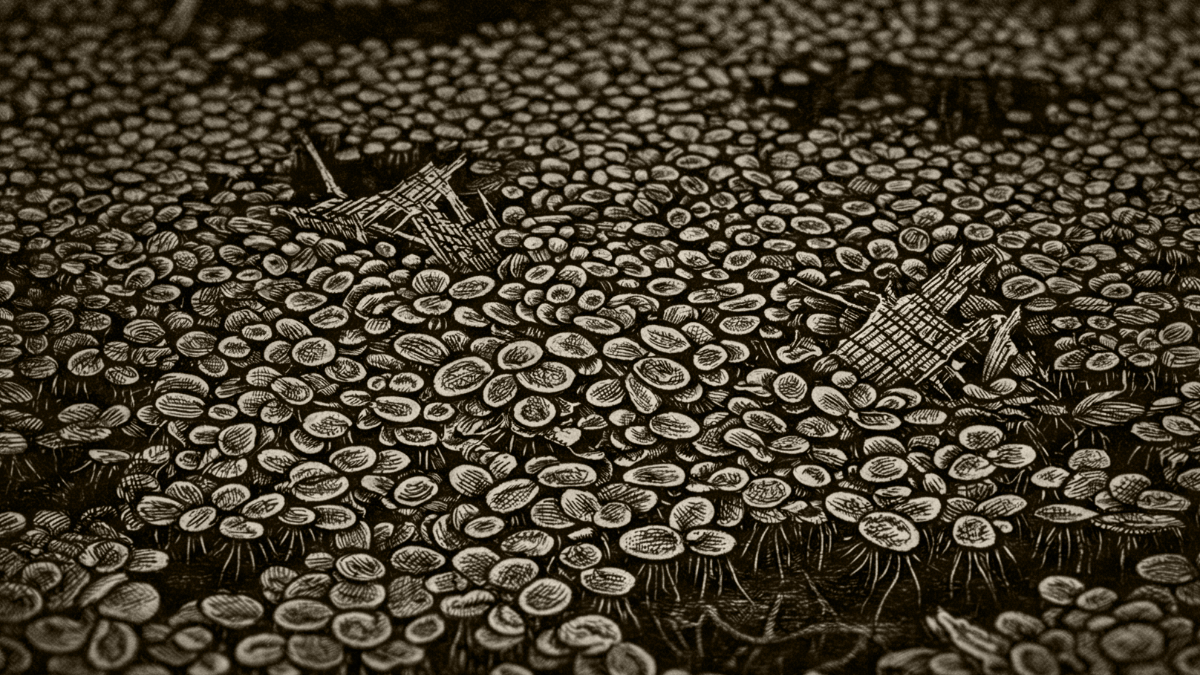 The duckweed-covered mill pond at Astley, c.1890.
The green world
There is a strand of interpretation that places Jenny in a broader tradition of green spirits, figures whose colour connects them not to death or disease but to the natural world in its more indifferent aspect. Green in this reading is not the green of decay but the green of things that grow without regard for human welfare: weed, algae, the unmanaged water that does not know it is dangerous.
The countryside in this tradition is not hostile. It is simply not on your side. Jenny does not hate the children she takes. She is not pursuing a grudge or enacting a punishment. She is doing what still, weed-covered water does, which is to be there, patient and cold and exactly as deep as it is, indifferent to whatever comes to the edge and leans over.
This indifference is older than the nursery-bogeyman function and sits uneasily with it. A creature used to warn children needs to be frightening, and Jenny is frightening. But beneath the pedagogical surface something else is present — a figure who is not a monster but a condition, who does not choose her victims because she does not choose at all. She is the pond. She is the weed. She is what happens when you fall in.
What she looks like now
Jenny Greenteeth has had a considerable afterlife in contemporary folk horror and children’s literature, where she appears regularly as a stock water witch, teeth bared, clawing upward from murky water. The illustrations are usually dramatic; she has become a figure of active malevolence, lunging and grasping.
This is not the Jenny of the original tradition. The original figure does not lunge. She does not grasp dramatically. She waits. Her horror is specifically the horror of patience, of something that has been in the same place, beneath the same duckweed, for longer than you have been alive, and will still be there when you are gone.
The Lancashire ponds she was said to inhabit are still there, most of them. Some have been drained, some have been fenced, some have acquired warning signs in the language of modern hazard management. The duckweed still grows on the ones that remain. In the right conditions, in late summer, the surface still looks almost solid.
She is very old and very patient, and she has heard about the warning signs.