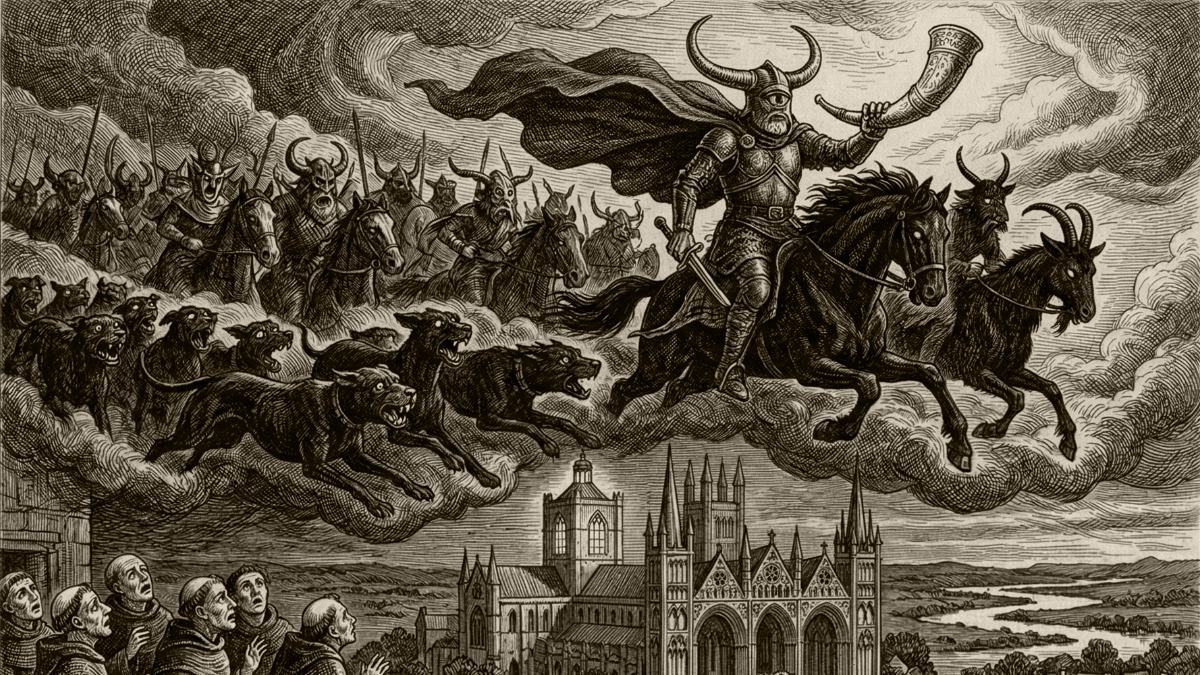
In the year 1127, the Anglo-Saxon Chronicle records something that its author clearly felt required documentation. At Peterborough, in the week after a new abbot arrived at the monastery, an unpopular appointment, widely resented, local people reported seeing and hearing a Hunt in the night sky. The account is precise: a great number of hunters, black and huge, mounted on black horses and black he-goats, with hounds that were jet-black with wide eyes. They passed over the town making a great noise, and the sightings lasted from the evening into the following morning. Many monks said they heard the horns.
The Chronicle is a sober document, concerned with battles, appointments, and harvests. It is not in the habit of recording folklore. The fact that this account appears in it at all suggests the compilers felt they were setting down something that had genuinely happened, or at least that enough people believed had happened that it warranted a place in the historical record.
They were working, whether they knew it or not, with material that was already ancient.
What the Hunt is
The Wild Hunt is not a single legend but a category, a form that recurs across northern and western Europe with enough consistency to suggest a common origin, even as the local details shift dramatically. The essential elements are these: a host of riders crossing the sky, usually at night, usually in winter, accompanied by a pack of hounds. They are loud. They move fast. They are not to be interfered with. To see them is at best an omen of death or disaster; at worst, to see them is to be swept up and taken along.
Who leads the Hunt varies by location and tradition. In Germany it is Wotan, the one-eyed god striding across the storm. In Scandinavia, Odin. In England the leader changes face depending on where you stand. In Windsor Great Park it is Herne the Hunter, antlered, chained, still circling the oak where he hanged himself — or was hanged, the accounts differ. In the north of England the leader is sometimes referred to simply as Old Nick. In Cornwall, it is Dando, a dissolute priest whose love of hunting extended so far that he declared he would ride with the devil himself, and eventually did.
The hounds also change names. In Yorkshire they are Gabriel’s Hounds, the Gabble Retchets, their cries mistaken in daylight for the calls of geese flying high. In the West Country they are the Yeth Hounds, headless, the souls of unbaptised children. In Wales they are the Cŵn Annwn, the hounds of the Otherworld, white with red ears, appearing in the Mabinogion in a form that is neither threatening nor benign, simply other.
The Norse root
The most persuasive account of the Hunt’s origin runs through the Norse concept of the Oskoreia, the Terrible Host, and further back into an Indo-European tradition of the warrior dead. Odin leads his einherjar, the honoured dead of the battlefield, and the procession is connected to the Wilde Jagd documented across German-speaking lands from the medieval period onward. The common thread is the dead in motion: not at rest, not in any stable afterlife, but riding, moving, making noise.
The Danelaw settlers who reshaped northern England between the ninth and eleventh centuries brought this material with them. The geography of the Hunt’s strongest English traditions maps almost exactly onto the areas of heaviest Norse settlement — Yorkshire, Lincolnshire, East Anglia, the East Midlands. The Peterborough Chronicle entry comes from the heart of this territory.
What they found when they arrived was not an empty tradition. The British and Anglo-Saxon populations already had their own versions of the wandering dead, their own sky-riders, their own winter processions. The Norse material layered over existing beliefs rather than replacing them, which is why the Hunt in England is so much more various than its continental counterparts; it absorbed everything it encountered.
Herne the Hunter
Of all the English Hunt leaders, Herne is the most durably embedded in the landscape. His oak stood in Windsor Great Park for centuries, a specific, locatable tree at which the apparition was said to appear, usually in times of national crisis. Shakespeare puts him in The Merry Wives of Windsor, which dates the tradition in that form to at least the 1590s, though the play treats him as a well-known piece of local folklore rather than something requiring explanation.
The oak fell in 1796. A replacement was planted and designated Herne’s Oak. That one was blown down in a storm in 1863. Another replacement was planted by Edward VII. The current Herne’s Oak is therefore the third tree to carry the name, a piece of landscape mythology maintained by official designation rather than continuous tradition.
What this illustrates is something true of the Hunt more broadly: the tradition requires maintenance. Someone must keep telling it. The Peterborough chronicler was doing this in 1127, as was Shakespeare in the 1590s, as is every account written since. The Hunt does not sustain itself automatically. It persists because people have found it worth preserving, which says something, though it is not entirely clear what, about what the image of the sky-riders answers in the human imagination.
What people are actually hearing
The Gabriel’s Hounds phenomenon has a rational explanation that does nothing to diminish its effectiveness as a piece of folklore. Pink-footed geese, flying at altitude in formation, produce a sound that carries across many miles and that, heard at night without visual reference, is genuinely difficult to identify. The calls are sharp, repetitive, slightly eerie. To someone familiar with hound-cry and not with high-altitude geese, the association is not absurd.
The rationalist explanation and the folkloric one are not mutually exclusive. People heard something, named it, and the naming attached to a much older set of associations about the dead in motion. The geese became the hounds became the riders became the Hunt. The sky was never empty. The question was always what you decided was filling it.
The calendar of the Hunt
The Hunt is overwhelmingly a winter phenomenon. Its high season runs from the end of October — Samhain, the boundary between the world of the living and the dead in the old calendar — through the Twelve Days of Christmas, and particularly concentrated around the winter solstice. This is the time of year when the nights are longest, when food stores are at their most uncertain, when death is most present as a practical concern.
The association with the dead is not incidental. The Hunt is, in most of its forms, the dead riding, the warriors fallen in battle, the souls of the unbaptised, the restless spirits of those who died violently or without proper rites. The winter sky is where they go when the veil between the living world and whatever comes after grows thin enough to allow passage.
To hear them passing is, in some versions of the tradition, to be offered a warning: get indoors, stay quiet, do not look up. The Hunt does not want witnesses. The worst outcomes are reserved for those who interfere, who try to speak to the riders, or who foolishly say they wish they could join the chase. These people occasionally get their wish.
The last serious outbreak of Hunt sightings in Britain occurred in the winter of 1854-55, when a series of mysterious footprints appeared overnight in the snow across Devon, a continuous trail of cloven-hoof marks running over rooftops, through gardens, across rivers, covering over a hundred miles. The Devil’s Footprints, as they became known, produced considerable local panic. Locals in some villages barricaded their doors. The Hunt was not explicitly named in most contemporary accounts, but the connection to the older tradition was present in the landscape even if people no longer had the vocabulary for it.
Whatever made those tracks was never identified. The snow melted. The doors were unbarred. But the impulse to look up at the winter sky with a particular quality of attention — half dread, half something that is not quite the opposite of dread — had been there long before 1855, and has not entirely gone away since.