The Border country between England and Scotland is a landscape defined by violence. For much of the medieval and early modern period, with the Reiver culture reaching its most intensive phase between roughly the fourteenth century and the union of the crowns in 1603, though border violence predated and outlasted those markers, this strip of land was subject to a sustained, endemic raiding culture that made ordinary agricultural life nearly impossible. The Reivers, as the Border clans were known, operated outside the jurisdiction of both crowns, stealing cattle, burning farms, and killing with a matter-of-fact efficiency that shocked visitors from the more settled parts of both kingdoms.
What this landscape produced, in the way that landscapes under sustained violence tend to produce particular things, was the Redcap.
The creature
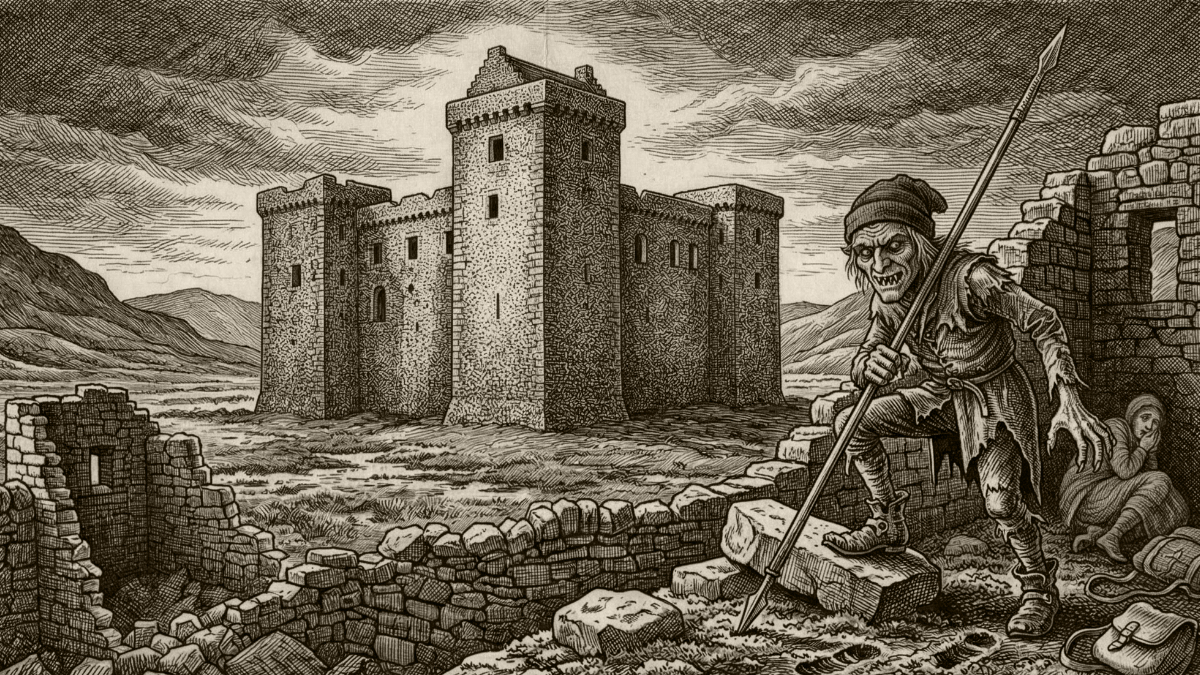
A Redcap is small. This is the first surprising thing; the folklore of Britain tends toward enormous malevolence, the giant, the great hound, the beast that fills a doorway. The Redcap is described as an old man, stunted and lean, with long prominent teeth, clawed hands, and eyes that glow a dull red. He carries a pikestaff. He wears iron-shod boots, which you will hear before you see him — the sound of iron on stone, coming faster than something that size should be able to move.
The cap is red because he dyes it. He dyes it in the blood of people killed on the ground where he lives, the ruins of old towers, old castles, the sites of battles and slaughter. The cap must be kept wet. If it dries, he weakens, and eventually dies. To keep it wet he must kill, and to kill he must find someone foolish or unlucky enough to take shelter in the wrong ruin on the wrong night. He then drops large stones on them from above, or corners them with the pikestaff, and the cap is refreshed.
He is very fast despite the iron boots. Outrunning him is not considered a viable strategy.
The only protection
The Redcap cannot withstand two things: a crucifix held up in his path, at which he shrieks and vanishes, leaving behind a large tooth as evidence of his departure; or the words of scripture spoken aloud, which have the same effect. This places him in a specific theological category — not a demon exactly, but something that the Christian supernatural order can repel without destroying. He retreats. The tooth remains. He will be somewhere else the following night, in a different ruin, waiting.
This detail about the tooth has the texture of something very old — the physical residue of the encounter, the proof that it happened, the object you bring back. Similar motifs appear across European fairy folklore: the transaction with the supernatural that always leaves something behind, a mark or an object or a memory that cannot be fully explained away. The Redcap’s tooth is that residue made literal.
Robin Redcap
The most famous specific Redcap is attached to Hermitage Castle in Roxburghshire, a building that generates more concentrated darkness per square foot than almost anywhere else in Britain. Hermitage was the seat, in the fourteenth century, of William de Soulis, a lord of such consistent and documented cruelty that he achieved a kind of legendary status while still alive. He was accused of sorcery, of using the castle for rituals that required the blood of local children, of making a compact with a spirit called Robin Redcap who served as his familiar and protected him from harm.
The compact, as recorded in the ballads about de Soulis, specified that he could not be harmed by steel, could not be bound by rope, could not be drowned in water. His neighbours, having exhausted conventional options, eventually took him to the top of a nearby hill, wrapped him in lead, and boiled him in a cauldron. The ballad tradition presents the boiling as the only solution to an otherwise unkillable man. The historical record is more prosaic: de Soulis was arrested in 1320 on charges of conspiracy against Robert the Bruce and died in prison. The boiling in lead belongs to legend, not to history, though it is the version that attached itself to the landscape and stayed.
Robin Redcap remained at Hermitage. He is there still, according to the tradition. The castle ruins stand in a flat, boggy valley with no trees, surrounded by hills that press in from every side. It is a cold place even in summer, and the building itself, squat, massive, largely intact, has an atmosphere that is not easily attributed to architecture alone. Mary Queen of Scots rode sixty miles in a day to visit the Earl of Bothwell there in 1566, and was so ill on the return journey that she nearly died. Whether the castle caused this or merely hosted it depends on your disposition.
The border context
It is worth thinking about why the Redcap is specifically a Border creature, found in this landscape and not elsewhere. England and Scotland both have rich traditions of malevolent fairy-type entities, but the Redcap’s particular combination of characteristics — the blood-dependence, the iron boots, the ruins, the speed — belongs to the Border country in a way that seems more than coincidental.
The peel towers where Redcaps are said to live were built as refuge against the Reivers. They are places that exist because of violence, designed around the expectation of attack. Many of them saw actual killing, sieges, ambushes, the slow deaths of people trapped without food or water, waiting for raiders to lose patience or move on. The ground beneath them absorbed this.
The Redcap is what that ground produces. He is, in one reading, the violence of the landscape made small and specific and capable of being encountered — given a face, a cap, a pikestaff, a sound you can identify. He is the thing that explains why you feel watched in the ruins, why the towers are cold in ways that go beyond stone and shadow, why sensible people have always found reasons not to shelter in them after dark.
The blood-soaked cap is not incidental to his nature. It is his nature. He is made of the blood in the ground, and he requires more of the same to continue existing. As long as there are ruins in the Border country, and there are a great many ruins in the Border country, the Redcap has places to be.
What survives
The Reiver culture that produced the Redcap is long gone. The Border has been peaceful for four centuries. The peel towers have become tourist attractions, farm buildings, holiday lets. Hermitage is maintained by Historic Environment Scotland and opens to visitors in summer. The car park is gravelled.
The Redcap persists in the folklore collections, in Katharine Briggs’s exhaustive cataloguing of British fairy types, in the Border ballads, in the local traditions still attached to specific towers and ruins. He appears, occasionally, in places he has no obvious business being: the folklore of Northumberland, a sighting or an account from somewhere that was never properly Reiver country, as though the type is more portable than its origin would suggest.
This may mean nothing. Folklore travels, detaches from its geographic roots, reattaches elsewhere. The Redcap could simply be a story that moved.
Or the ruins multiplied, and where ruins go, he follows. Britain has never been short of either.