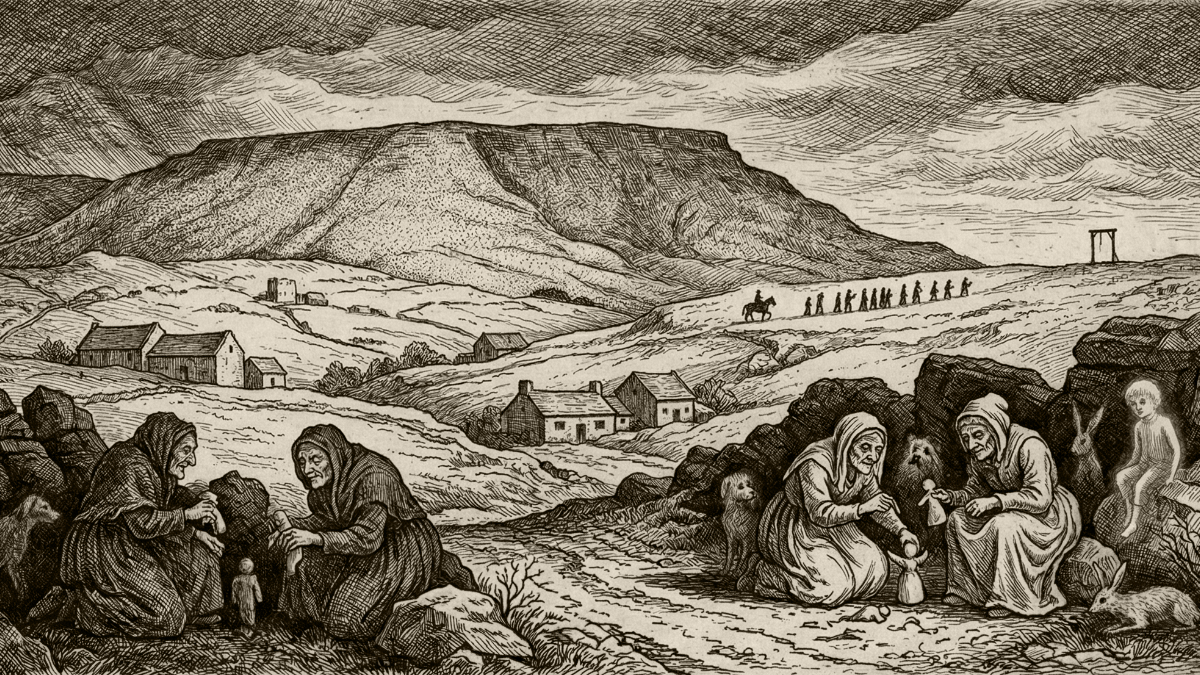
The Forest of Pendle is not a forest in any meaningful contemporary sense. It is open moorland, high and exposed, running along a sandstone ridge in the east of Lancashire between Burnley and Clitheroe. The word forest here is an old one, a royal hunting ground, once. In 1612 it was a landscape of scattered farmsteads, poor soil, and people who lived at a significant remove from the administrative centres of English life.
This distance matters. What happened in Pendle in 1612 was not a random eruption of witch-hunting hysteria. It was the product of a specific community, a specific landscape, and a specific set of circumstances that had been developing for at least two generations before a magistrate named Roger Nowell began collecting testimony in March of that year.
The families
At the centre of the trials were two families from the township of Pendle: the Demdike clan, led by the matriarch Elizabeth Southerns, known as Old Demdike, and the Device family, her daughter Elizabeth Device and grandchildren James and Alizon. Against them, and eventually alongside them in the dock, were the Chattox family, Anne Whittle, known as Old Chattox, and her daughter Anne Redferne.
Old Demdike and Old Chattox were both reputed cunning women. This is the term that matters, and it is not synonymous with witch in the sense the trials would make of it. Cunning folk were practitioners of a form of local magic that had coexisted with the Church in England for centuries, charm-working, healing, finding lost objects, identifying thieves, treating livestock. They occupied a recognised, if ambiguous, social role. People paid them for their services. They were part of how a community managed the unpredictable.
Both women, by 1612, were very old and very poor. Old Demdike was said to be nearly eighty and nearly blind. Old Chattox was not much younger. The families between them had a long-running dispute over a bag of oatmeal, and each had, over the years, accused the other of maleficent magic. They had been circling each other in a state of low-level supernatural warfare for years before the trials brought everything into a courtroom.
How it began
The immediate trigger was an encounter on the road near Colne in March 1612. Alizon Device, granddaughter of Old Demdike, met a pedlar named John Law. She asked him for pins, a standard item in charm-working, and he refused, or was unable to help her. Shortly afterwards he suffered what appears to have been a stroke. Alizon, apparently convinced she had caused it through witchcraft, confessed as much when brought before Roger Nowell.
She then named her grandmother.
What followed was a catastrophic unravelling. Old Demdike, brought before Nowell, made a detailed confession that described her own initiation into witchcraft twenty years earlier — a spirit appearing to her in the shape of a boy, asking for her soul, receiving it. She described a familiar spirit she called Tibb. She implicated her family. Old Chattox, brought in shortly afterward, made her own confession and implicated hers. The families, long in conflict, did not protect each other.
The machinery of the 1604 Witchcraft Act, passed by James I, who had a documented personal obsession with witchcraft, now had what it needed.
The Good Friday meeting
While the adults were in custody awaiting trial, something occurred at Malkin Tower, the Device family home, on Good Friday, 1612. A meeting took place. Twenty people attended, or thereabouts. The stated purpose, according to James Device’s later testimony, was to discuss freeing the prisoners from Lancaster Castle. A more dramatic version, which James provided under examination, held that the assembled company had planned to blow up the castle and kill the gaoler.
This meeting, which may have been nothing more than a gathering of neighbours and family anxious about imprisoned relatives, became the scaffold on which the wider accusations were built. The names James Device provided under questioning, whether under duress, under genuine belief, or in an attempt to bargain, supplied the rest of the accused.
What they believed
The confessions from the Pendle trials are remarkable documents, and not primarily because they reveal persecution. They reveal, in unusual detail, what a community of cunning folk in early seventeenth-century Lancashire actually believed about the nature of their practice.
The familiar spirits are consistently described in domestic, almost banal terms. Demdike’s Tibb appears sometimes as a boy, sometimes as a brown dog, sometimes as a hare. Chattox’s familiar was called Fancie, described as a man. These are not the demons of theological demonology; they are closer to household spirits, beings with whom a working relationship had been established over years. The compacts described are not Faustian bargains for unlimited power; they are modest arrangements, exchanging the soul for the capacity to perform specific small workings.
The magic described in the confessions is recognisably cunning craft. There are clay images — poppets — used to harm enemies. There are verbal charms, some of which have a clear pre-Reformation Catholic structure, calling on the Trinity and the Virgin. There are accounts of healing animals and finding thieves. The killing magic attributed to the accused tends to follow a pattern: a quarrel with a neighbour, an image made, a death following days or weeks later. Whether the accused believed they had done what they confessed to is impossible to determine at this distance. That they inhabited a world in which these things were possible, in which a cunning woman could cause a man to fall ill on a road by wishing it, seems clear.
This is not the world of theatrical Satanism the court wanted to find. It is something older and more local: a folk religious practice that had survived the Reformation in the remote uplands of Lancashire, largely intact, because no one had looked closely enough to dismantle it.
The hangings
Twenty people were tried at Lancaster Assizes in August 1612. Eleven were from Pendle. Of these, ten were hanged on the moor above Lancaster Castle on 20 August. Old Demdike did not survive to trial; she died in prison. Old Chattox was hanged. Anne Redferne was hanged. Elizabeth Device was hanged, along with her son James and her daughter Alizon.
Jennet Device, the youngest of the Device children, had given the most damning testimony against her own family. She was nine years old. Her evidence identifying her mother, brother, and sister was accepted by the court. It is difficult to know what to make of this: a child shaped by a world in which her family genuinely believed they practised maleficent magic, giving testimony that she may have understood as true, in a courtroom that was predisposed to accept it.
Twenty years later, in 1633, Jennet Device herself was accused of witchcraft. The wheel had turned.
The hill
Pendle Hill stands over the forest that bears its name, a broad, flat-topped mass of millstone grit, 557 metres at its highest point. It is visible from most of the surrounding country. In 1652, the Quaker George Fox climbed it and had a vision: a great multitude of people to be gathered to Christ. The hill has held both of these things since, the memory of the hangings and the memory of the vision — the darkness and the revelation — sitting on the same high ground.
The accused are memorialised now in the village of Barley, at the base of the hill. There is a sculpture. There are walking routes. The tourist economy of the Ribble Valley makes considerable use of them. They have become, like most of the victims of the witch trials, a story about injustice rather than a story about belief.
The injustice is real and should not be minimised. But something is lost in the reduction — the texture of the world Old Demdike and Old Chattox actually inhabited, in which the magic was real, the spirits had names, and the landscape of Pendle was alive in ways that the court record captures only in the act of destroying.