John Lambton was fishing in the River Wear on a Sunday morning when he should have been at church. This is the first sin, and it is treated as such in every version of the story, not fishing on a Sunday as a minor social transgression, but as a genuine moral failure that sets in motion a chain of consequences lasting generations. What he caught was not a fish.
The creature on the end of his line was small, dark, eel-like, with nine holes on each side of its head in place of gills. It was, by any account, unpleasant. Lambton, unwilling to throw it back into the river, and unwilling to carry it home, dropped it into a well at the side of the road and went back to his fishing. He caught nothing else that day.
The well was Worm Well, near Lambton Castle in County Durham. It still exists, though it has been dry for centuries.
What grew in the well
The creature in the well was not a worm in the sense of an earthworm. The word carried a different freight in northern English dialect; it was the term used for a dragon, specifically the legless, serpentine type that appeared in Scandinavian and Anglo-Saxon tradition, distinct from the winged fire-breather of later medieval imagination. The Worm of the Lambton legend belongs to this older category: vast, boneless, coiling.
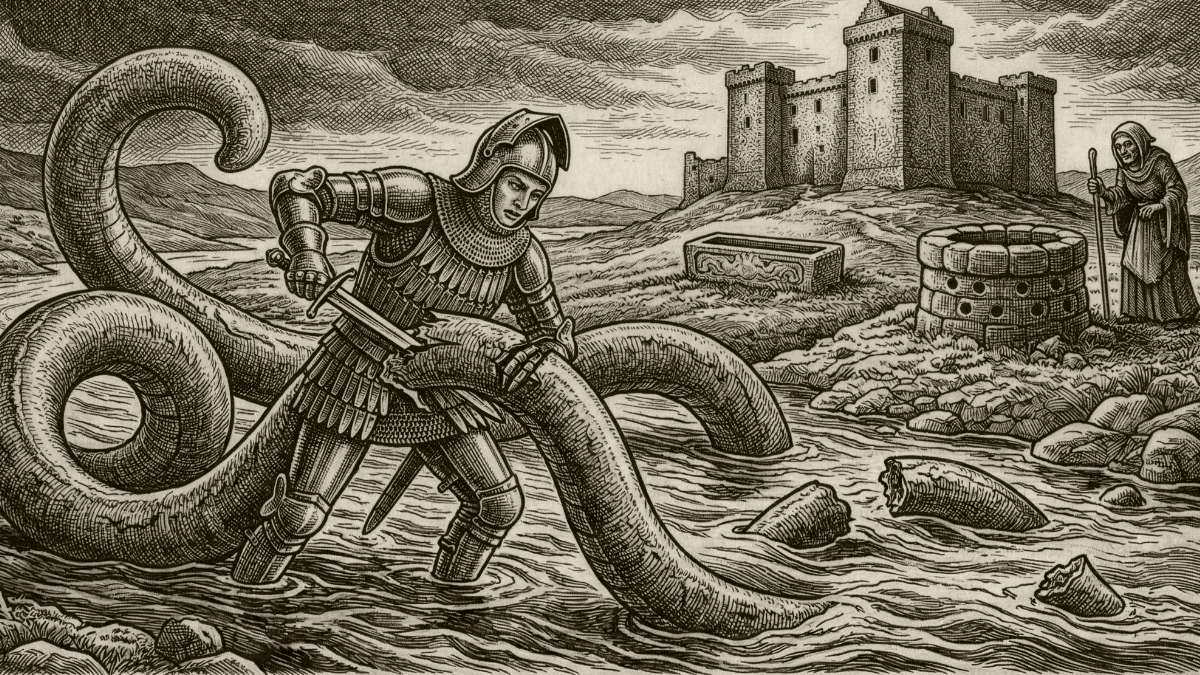
It grew in the well for years. When it became too large for the well it emerged and made its way to the River Wear, where it lay along the riverbed by day, wrapped around a rock in the middle of the current, and came ashore at night to raid the surrounding country. It coiled itself around Worm Hill, a low mound that still exists near the village of Washington, and when disturbed it could not be killed by ordinary means. If cut in two, the halves rejoined. If cut into pieces, the pieces reassembled. Every sword, every axe, every attempt at conventional destruction failed and was undone before sunrise.
The country around Lambton was being systematically destroyed. Cattle disappeared. People stopped moving at night. The Lambton family, guilty by association if not by direct culpability, attempted to appease the creature with a daily offering of nine cows’ worth of milk, placed in a trough of carved stone by the Wear. When the milk was forthcoming the Worm drank and was quiet. When it was not, it took what it wanted and wrapped itself around trees until they died.
The heir returns
John Lambton, who had grown up and gone to the Crusades in the meantime — a detail added to the legend that conveniently explains both his long absence and the moral improvement required by the story — came home to find his father’s estate in a state of low-level ruin. He consulted a wise woman, which is the older, more accurate term for what later accounts sanitise into a witch or a seer.
She told him what he needed to know. The Worm was his responsibility. He had caught it, discarded it carelessly, and the consequences were his to resolve. She gave him the method of its killing: he must have his armour fitted with spearheads, long razor blades projecting from the surface, and he must fight it in the river, where the current would carry the severed pieces away before they could rejoin. Fighting it on land would be useless; the halves would simply reconnect.
She also told him the price. After killing the Worm, Lambton must kill the first living thing he met on his return home. If he failed to do this, no Lambton would die in his bed for nine generations.
This second condition is the hinge on which the whole legend turns.
The compact and its breach
Lambton agreed. He arranged with his father that when he heard the hunting horn — the signal that the Worm was dead — his father should release his favourite hound, so that the dog, rather than any person, would be the first living thing to meet him.
The plan worked perfectly against the Worm. Lambton waded into the Wear in his bladed armour, the creature coiled around him and was cut to pieces by its own embrace, and the current swept each piece away before it could rejoin. The Worm died in the river. Lambton sounded his horn.
His father, overcome with relief, forgot the arrangement entirely and ran out to embrace his son.
Lambton could not kill his father. He killed the hound when it arrived, but it was too late; the first living thing had already met him. The wise woman’s condition had been breached. The curse took hold.
Nine generations
The curse held, the legend maintains, for nine generations of the Lambton family. No Lambton, during that period, died in his bed. The deaths were various: in battle, by drowning, by accident, in circumstances that seemed to make natural death impossible. The family’s history, which is documented in reasonable detail from the medieval period onward, does contain an unusual number of violent and premature deaths, though the historical record is not quite as obligingly consistent as the legend would prefer.
The last of the cursed generations is usually identified as Henry Lambton, who died in his carriage crossing a bridge in 1761 and who, by the accounting of the legend, represented the ninth. After him, the curse was considered discharged. Whether the Lambton family’s subsequent members have died in their beds at a statistically normal rate is not something the legend addresses.
What kind of story this is
The Lambton Worm is unusual in English folklore because it has an identified origin point, a specific family, a specific place, a specific individual held responsible, and a consequence that extends through documented genealogical history. Most creature legends are anonymous: the thing in the moor, the black dog at the ford, the giant in the hill. The Worm is attached to a surname, a castle, a river, a datable period. This concreteness is part of why the legend has lasted so well.
It is also a story about the particular cruelty of conditions. The wise woman does not set Lambton an impossible task; he succeeds. She does not demand anything unreasonable of him. She simply tells him that the price of resolution is a death, and that he must choose whose. His failure is not of courage or competence but of planning, and one moment’s parental emotion undoes the whole arrangement.
The nine generations of cursed Lambtons are the cost of that single failure, multiplied across time. The family carries what John Lambton could not finish, through descendants who had no part in either the original transgression or the botched reckoning. This is not a morality tale with a clean lesson. It is a story about how mistakes propagate, how the consequences of carelessness outlast the careless, and how the debts of the dead are collected from the living.
Worm Hill is still there, east of Washington, now within sight of the Angel of the North. The River Wear still runs through County Durham. The rock in the middle of the current, the one the Worm used to coil around, in the stories, has never been definitively identified. Presumably it is still there too, smoothed by nine centuries of water, waiting for nothing in particular.