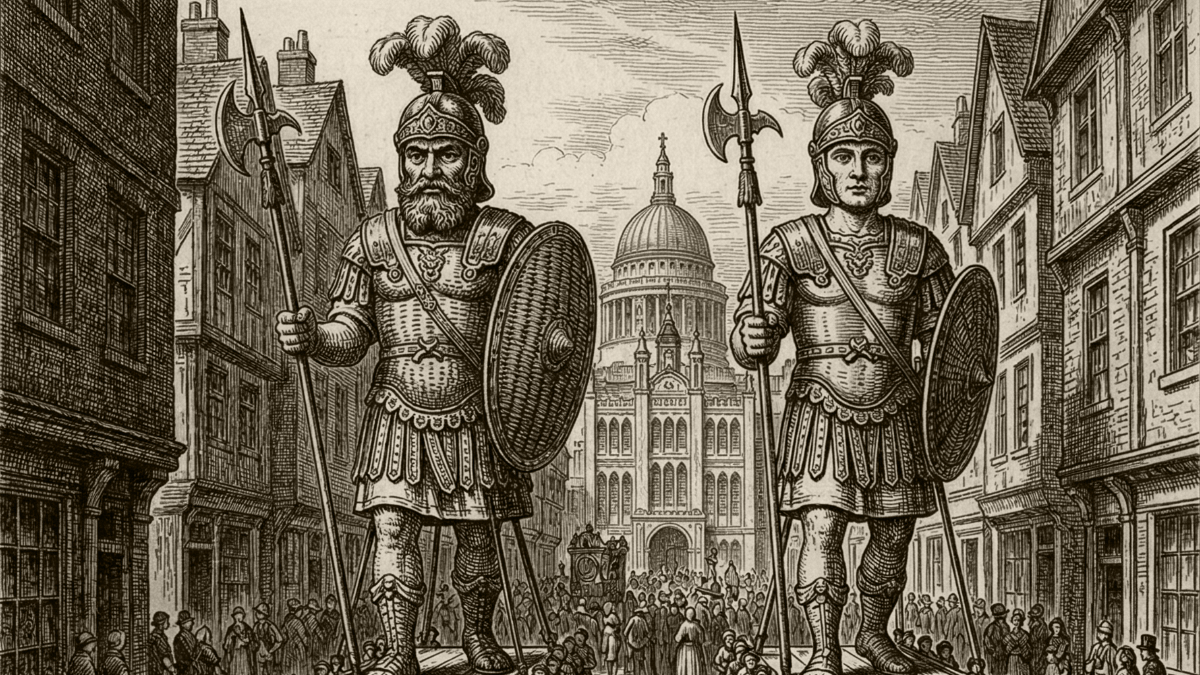
Every Lord Mayor’s Show, two giants are carried through the streets of the City of London. They are wicker-framed figures, eleven feet tall, dressed in Roman armour with feathered helmets, and they have been part of the procession since at least the reign of Henry V. The crowds watch them pass. Children are lifted onto shoulders. Then the procession moves on and the parade figures are retired until the following year.
In the Guildhall itself, a separate pair of giants stands permanently in alcoves on either side of the western gallery, carved limewood statues, nine feet tall, installed in 1953. These are not the parade figures. They are the latest in a series of fixed effigies that have occupied the Guildhall since the eighteenth century, looking out over a room where the City has conducted its business for the better part of a millennium. The parade tradition and the Guildhall statues are two distinct manifestations of the same myth, running in parallel for centuries.
Their names, in both cases, are Gog and Magog. Where they came from, and what they actually are, is a question that has occupied theologians, antiquarians, and mythographers for two thousand years without producing a settled answer.
The biblical inheritance
In the Book of Ezekiel, Gog is a prince, a ruler from the land of Magog, in the far north, who will lead a great coalition of nations against Israel in the last days. He will come like a storm. His armies will cover the land like a cloud. God will defeat him on the mountains, and his bones will lie in the valley for seven months while the people of Israel bury them. The passage is one of the most elaborate prophecies in the Hebrew Bible, and it lodged itself deeply in the apocalyptic imagination of subsequent centuries.
In the Book of Revelation, Gog and Magog reappear, no longer a prince and his territory, but two distinct nations, released by Satan after the millennium to make war on the saints. They are destroyed by fire from heaven. The shift from singular to plural, from person to people, opened a gap that interpreters rushed to fill.
By the medieval period, Gog and Magog had become a cartographic fact. The Hereford Mappa Mundi, drawn around 1300, places them behind a wall in the far northeast of the known world, enclosed there by Alexander the Great to prevent them from overrunning civilisation. They are depicted as cannibals. The wall is sometimes identified with the Caucasus, sometimes with the Great Wall of China. The point, in each case, is the same: the giants are out there, beyond the edge of the known, and something is holding them back.
The British mutation
What the giants are doing in the Guildhall requires a separate explanation, because the London Gog and Magog have almost nothing to do with Ezekiel or Revelation. They are the product of a distinctly British act of mythological appropriation, carried out in the twelfth century and developed with considerable shamelessness thereafter.
Geoffrey of Monmouth, writing his Historia Regum Britanniae around 1136, needed giants for his founding myth of Britain. He found them in a tradition that had attached the names Gog and Magog to two enormous figures who had supposedly inhabited Albion before the Trojan Brutus arrived and gave the island his name. In Geoffrey’s account, Brutus and his companion Corineus defeated the giants in battle. The last of them, Gogmagog, here a single creature, was wrestled to the cliff’s edge by Corineus and thrown into the sea. The place where this happened became Plymouth Hoe.
The story is invented. Geoffrey was a mythographer of spectacular ambition and limited concern for source material. But it gave England its own giants, rooted in the landscape, prior to and defeated by the founding act of civilisation. By the fifteenth century they had been separated back into two figures, given Roman dress to reinforce their antiquity, and installed as guardians of the City.
The figures in the Guildhall
The current statues are not old. The originals, wicker figures carried in procession, probably dating to the early fifteenth century, were destroyed in the Great Fire of 1666. Replacements were made and installed in the Guildhall in 1708. Those were destroyed in the Blitz in 1940. The present figures were carved in limewood by David Evans and installed in 1953, in time for the coronation of Elizabeth II.
So the physical objects are young. What they represent is the persistence of an idea across six centuries of catastrophe and reconstruction; each time the City was destroyed, it rebuilt its giants.
They stand nine feet tall in carved wood, painted and gilded, carrying halberds and shields. Gog, on the left, is bearded; Magog, on the right, is clean-shaven. The distinction appears to be aesthetic rather than meaningful; no source gives a convincing reason for it. Their expressions are difficult to read. Neither looks threatening, exactly. Neither looks entirely benign.
Two hills in Cambridge
The story does not stay in London. On the eastern edge of Cambridge, two low chalk hills rise from the surrounding plain. They are called Gog Magog Hills, a single name for a single place — the giants collapsed back into one entity, or perhaps never fully separated here. The hills are the highest ground for miles in any direction, which in the fens is not saying much. Bronze Age people built a hill fort on them. Iron Age people reinforced it. Roman roads converge nearby.
The antiquarian William Stukeley, visiting in the eighteenth century, became convinced that the hills preserved a memory of the giants, that the name was genuinely ancient, pre-Geoffrey, evidence of a tradition that ran deeper than any single writer’s invention. Modern scholars are sceptical. The earliest recorded reference to the name dates only to the sixteenth century, and may simply be a borrowing from the London tradition. But the hills are real, and the name has stuck for five hundred years, and on a grey morning when the mist is coming in from the fens, the question of what came before the name feels live in a way that scholarship doesn’t quite extinguish.
What persists
The peculiarity of Gog and Magog is that they mean different things in every context they appear in. In Ezekiel they are an eschatological threat. In Revelation they are the final enemy. On medieval maps they are a contained barbarism at the world’s edge. In Geoffrey of Monmouth they are the indigenous giants displaced by civilisation. In the Guildhall they are guardians of the City, protectors of trade and law. In Cambridge they are the landscape itself, given a name and left to weather.
No other figures in the British mythological tradition have been put to so many contradictory uses, across so many centuries, in so many different registers. They are simultaneously the thing that must be defeated and the thing that, once defeated, stands watch over what replaced it. The ambiguity appears to be the point.
The wicker figures still go out every November, borne on shoulders through the streets of the Square Mile. The carved figures still stand in the Guildhall, halberds raised. The chalk hills outside Cambridge are still called by their name. Whatever Gog and Magog originally were — if they were ever anything singular enough to have an original — they have long since become something the landscape cannot do without.