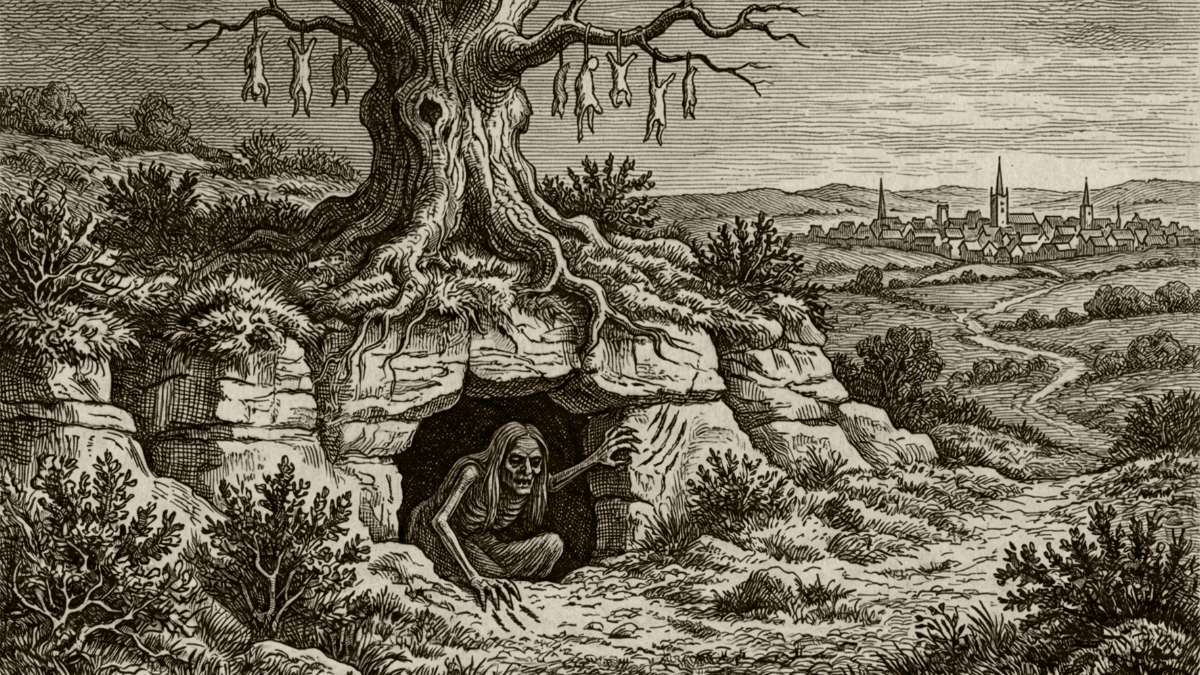
The Dane Hills are not hills in any meaningful sense. They are a low sandstone ridge on the western edge of Leicester, now largely absorbed by suburban development, playing fields, a golf course, residential streets with unremarkable names. There is nothing obviously sinister about them. In the eighteenth century, before the city reached them, they were covered in oak woodland and looked out over open country. It was there, in the face of the sandstone, that Black Annis was said to have her bower.
She dug it herself. That detail appears in every account, and it carries a specific kind of dread: not a cave that happened to exist, not a ruin she had moved into, but a hollow she had created over years using only her iron claws, gouging the soft rock until she had a space large enough to crouch in. The claws left marks in the stone. People claimed to have seen them.
The shape of her
Black Annis is a hag, the specific English folkloric type, distinct from the witch, older than the fairy, and more difficult to locate in any single tradition. She has a blue face, which is not the pallor of death but something stranger, a living blue that belongs to cold water and winter sky. Her single eye is mentioned in some accounts; others give her two. She has iron claws, long enough to snatch a child from a considerable distance. She is very old. She eats what she catches.
Her cottage oak stood at the entrance to the bower, a tree so ancient that its age had become unimaginable, mentioned in records from the sixteenth century as already venerable. She would hang the skins of her victims from its branches to dry. Children’s skins, mostly. She had a particular appetite for children, as hags tend to, and she would range at night across the surrounding fields to find them, moving faster than should have been possible for something of her apparent age and bulk.
Parents in Leicester used her name as an instrument of control for centuries. Black Annis will have you. The formula still appears in accounts from the early nineteenth century, by which point the bower itself had been filled in and the oak felled, but the name had outlasted the physical evidence of her existence.
Where she comes from
The origin of Black Annis is genuinely uncertain, and the theories that have been advanced are more revealing about the theorists than about the figure herself.
Victorian folklorists, drawn to the idea of paganism preserved in oral tradition, connected her to the goddess Anu or Danu of Celtic mythology, a great mother figure transformed by Christian hostility into something monstrous. The name supports this reading, superficially. So does the location: the Dane Hills may derive from Danu rather than from the Danes who settled eastern England. The theory has a satisfying shape, the fallen goddess turned cannibal hag, but the evidence for it is thin and the argument tends to run backwards from conclusion to supporting detail.
A more sober view holds that Black Annis is a local condensation of a widespread type, the monstrous feminine that appears across northern European folklore in various forms, the Baba Yaga of Slavic tradition, the Norse Huldra, the Scottish Cailleach. These figures share characteristics across cultures that had limited contact with each other, which suggests they are tapping into something that predates any specific tradition. What that something is, a memory of real danger, a personification of winter or starvation, a psychological structure that human minds reliably produce, is not agreed upon.
There is a third theory, traceable in Leicester antiquarian writing from the nineteenth century onward, that Black Annis is a distorted memory of a medieval anchoress named Agnes Scott, who lived as a hermit in a cell cut into the Dane Hills sandstone in the fifteenth century. The cell existed. Agnes Scott existed. The transformation of a holy woman into a child-eating hag would not be unprecedented in the history of English folklore, where the boundaries between the sacred and the monstrous have always been permeable.
None of these explanations excludes the others. She may be all of them at once.
The cat anna hunt
The most peculiar evidence for Black Annis’s hold on the local imagination is a custom recorded in the eighteenth century: the Easter Monday drag hunt, in which a dead cat soaked in aniseed was dragged from the Dane Hills to the walls of Leicester, with a pack of hounds following the scent. The hunt was called the Cat Anna Hunt. It began, by tradition, at her bower.
The custom has the structure of a ritual rather than a sport, the fixed starting point, the fixed destination, the symbolic cargo. What it was originally enacting is not recorded. By the time anyone thought to write it down, the participants had forgotten, or claimed to have forgotten, that it had any meaning beyond an excuse to ride and drink on Easter Monday.
It appears to have died out before the end of the eighteenth century, though fair traditions associated with the same ground continued separately. Within a generation of its disappearance, most people in Leicester had never heard of it.
What remains
The bower was filled in by a local landowner in the late eighteenth century, reportedly because it had become a meeting place for undesirables. The cottage oak was felled around the same time. The Dane Hills were gradually built over through the nineteenth and twentieth centuries. There is a Black Annis pub in Leicester — there has been one, in various locations, for two hundred years — and her name appears on local business signs and in children’s books about Leicestershire folklore, where she has been softened into something merely colourful.
The process by which a figure of genuine terror becomes a regional mascot is not unique to her. It happens to most things that frighten people long enough. The name survives, the claws get smaller, the children in the story escape, and eventually she is on a pub sign.
What is harder to soften is the original image: a blue face in a sandstone hollow, iron hands moving in the dark, and the sound, which some accounts mention, of her howling across the Dane Hills on winter nights, a sound that carried into the city and that people told themselves was the wind, because the alternative required them to check whether the door was bolted.