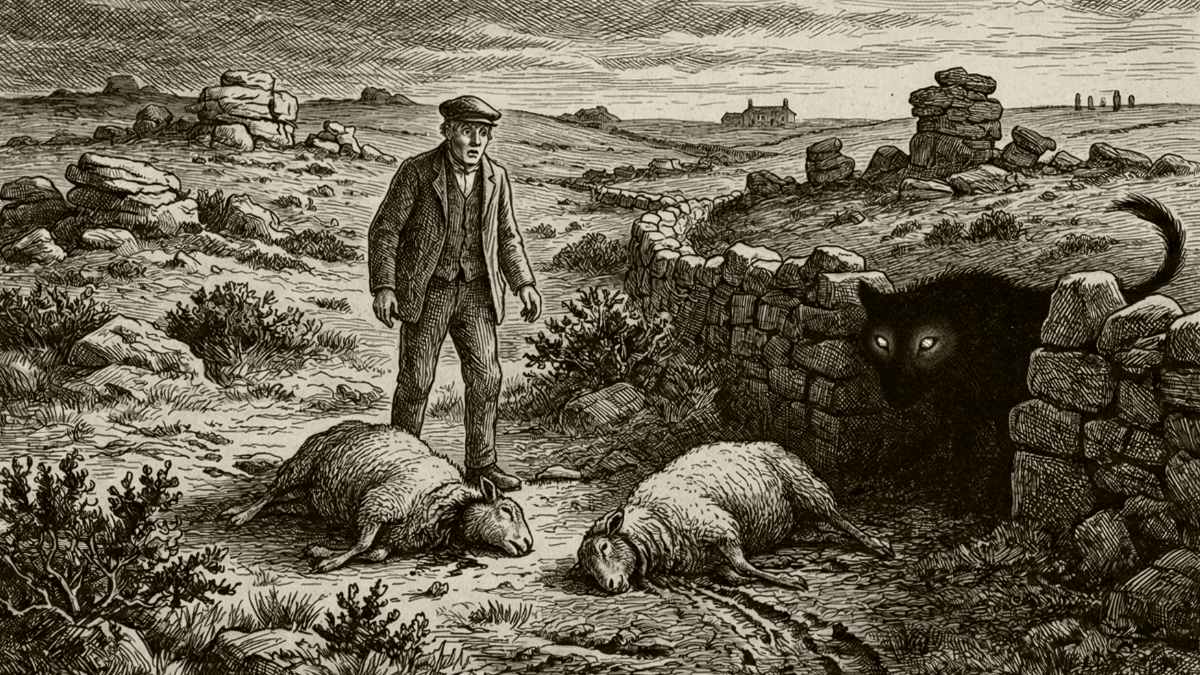
On the morning of 17 July 1983, a farmer near Bodmin found three of his sheep dead in the field. The wounds were unusual. The throat had been opened, cleanly, without the ragged tearing you’d expect from a dog, and one carcass had been partially dragged toward the treeline before being abandoned. He reported it to the police. The police noted it. Nothing further happened.
This is roughly how it always goes on Bodmin Moor.
The moor itself
Bodmin is the largest and highest moorland in southwest England: around eighty square miles of granite upland, bog, and rough grazing, running from the outskirts of Bodmin town in the south to the edge of Camelford in the north. It is not remote in the way that Dartmoor or the Scottish Highlands are remote — the A30 bisects it, and Jamaica Inn sits at its centre serving cream teas — but it has a particular quality of openness that can feel, in the right conditions, profoundly inhospitable. The tors rise suddenly from the heath. The weather comes in fast from the Atlantic. There is almost nowhere to hide, and yet things hide there.
The granite has been shaped and worked by people for six thousand years. There are stone circles, standing stones, chambered tombs, the remains of Bronze Age settlements. The moor has been inhabited longer than almost anywhere else in Britain, and it carries that weight. When the Beast is reported near Jamaica Inn or crossing the road at Bolventor, it is crossing ground that has been significant to human beings since before recorded history.
What people are seeing
The sightings are consistent in the details that matter. A large cat, not a domestic cat, not a fox, not a dog, black or very dark, moving low to the ground, with a long tail that curves upward at the tip. Estimates of size vary but cluster around that of a labrador, sometimes larger. The eyes, when caught in headlights, reflect amber or green. It moves quickly and without sound.
There have been hundreds of recorded sightings since the early 1980s. Many come from people with no interest in the folklore, lorry drivers, farmers, tourists who had never heard of the Beast before they saw it. A coastguard officer reported a sighting in 1994 that he described, with evident discomfort, as completely unambiguous. These are not, in the main, people who want attention.
The livestock deaths have continued at a low level across four decades. In 1995 a farmer found a large paw print in mud near a mauled sheep. A wildlife expert from Newquay Zoo examined a cast of it and said it was consistent with a large cat. He declined to be more specific than that.
The official position
In 1995, following sustained pressure from farmers and local MPs, the Ministry of Agriculture commissioned a formal investigation. Civil servants were dispatched to Cornwall. They examined evidence, interviewed witnesses, and produced a report. The report concluded that there was no verifiable evidence of a wild big cat living on Bodmin Moor, and that the livestock deaths were consistent with attacks by domestic dogs.
The report was published in July 1995. Six weeks later, a fourteen-year-old boy found a large skull on the banks of the River Fowey. It was sent to the Natural History Museum in London, where experts identified it as a young male leopard. The skull showed no signs of having been in the ground; it was not a fossil. Someone, or something, had brought it there recently.
The Ministry of Agriculture did not reopen its investigation. The skull, it emerged, had almost certainly been imported with a leopard-skin rug, possibly as a trophy, and discarded. This explanation is plausible. It did not end the sightings.
The most likely explanation
The leading theory among people who take this seriously, and there are serious people who do, is that the Beast, or Beasts, are the descendants of animals released into the wild in 1976, when the Dangerous Wild Animals Act came into force and required owners of exotic pets to obtain licences. Rather than comply, some owners released their animals. A puma caught in Perthshire in 1980 lends this theory credibility: the animal was healthy, well-fed, and had clearly been living wild for some time. If a puma survived in Scotland, a leopard or puma on the milder, game-rich uplands of Cornwall is not impossible.
The difficulty is forty years. Even a long-lived big cat would not account for sightings spanning four decades, which implies a breeding population. A breeding population of large black cats in southwest England, producing no roadkill, no confirmed kills, no trail camera footage that would satisfy a scientist — this requires a level of elusiveness that strains credibility even among believers.
And yet the sightings continue. A farmer outside Camelford reported one in the autumn of 2023, described in terms identical to those used by farmers in 1985. The same size, the same colouring, the same disturbing stillness before it moved into the gorse and was gone.
What the moor keeps
There is a version of this story that ends with the mystery solved, DNA evidence, a camera trap, a body found. It may still end that way. But Bodmin Moor has held onto this particular secret for the better part of half a century, and there is something in the landscape that seems to encourage it.
The moor is a place where things are neither fully present nor fully absent. The archaeology is everywhere but barely visible. The roads cross it without belonging to it. Even the light behaves differently there, flattening distances, making the tors appear and disappear as cloud shadows move across the heath.
Whether the Beast is a breeding population of leopards, a single long-lived animal, a series of unconnected sightings of different creatures, or something that resists straightforward explanation, it has become part of the moor’s character now. Farmers check their stock more carefully at dusk. Drivers slow down on the A30 at night, scanning the verge with a particular attention.
Something has earned that attention. Whether it can be photographed and catalogued is, perhaps, beside the point.